6 Steps for Self-Employed Bank Statement Mortgage Loans
· By the HomePilot team · Reviewed by a licensed loan officer · Company NMLS #2752340

If you’re self-employed and your tax returns understate what you actually earn, you can likely qualify for a mortgage using several months of bank statements instead. Lenders average your deposits, apply a business expense assumption, and calculate income from cash flow rather than your Schedule C. The trade-off is real: expect a higher rate, a bigger down payment, and non-QM underwriting rules that offer fewer built-in protections than a conventional loan.
TL;DR:
- Bank statement loans are higher-cost, flexible non-QM mortgages suited for self-employed borrowers whose tax returns understate income.
- These loans typically require 12 to 24 months of bank statements, a CPA-reviewed profit and loss statement, and proof of reserves, with credit scores usually above 620.
- Underwriters apply a default 50% expense ratio to deposits, but a CPA letter can lower this assumption and boost qualifying income.
- Interest rates are generally 1 to 3 percentage points above conventional loans, with higher down payment and reserve requirements, and some may include prepayment penalties.
- Tightening regulations mean more careful documentation and cautious underwriting, so accurate paperwork and reviewing offers early are essential for approval.
Table of Contents
- What Is a Bank Statement Mortgage Loan?
- Who Actually Benefits From This Loan Type?
- Requirements and Documents You’ll Need to Gather
- How Lenders Turn Deposits Into Qualifying Income
- Weighing the Pros and Cons
- How to Prepare and Apply, Step by Step
- How Regulatory Changes Are Reshaping This Market
- Common Pitfalls That Sink Applications
- Improving Your Approval Odds
- What Rates and Fees Actually Look Like
- An Editorial Take on When This Loan Makes Sense
- Get Matched to Bank Statement Programs Through HomePilot
- Sources
What Is a Bank Statement Mortgage Loan?
A bank statement loan is a non-qualified mortgage, or non-QM, that lets self-employed borrowers document income through deposit history instead of tax returns or W2s. The Consumer Financial Protection Bureau draws a hard line between qualified mortgages, which follow strict ability-to-repay rules and cap fees and loan features, and non-QM products, which give lenders more flexibility in how they verify income. Bank statement loans sit in that second category.
Most programs run on months of statements, and the difference matters. A 24-month average smooths out a slow quarter or a one-time client payout, which usually works in your favor if last year was stronger than the one before. Some programs also offer interest-only periods or 40-year terms to soften the payment, features you rarely see on conventional loans.
That flexibility carries a price. Experian notes that bank statement loans are underwritten on cash flow lenders can’t fully verify through the IRS, so they charge a rate premium to offset that added risk.
Who Actually Benefits From This Loan Type?
This product fits a narrow but real slice of borrowers, mostly people whose tax strategy works against them at the mortgage desk. Because Schedule C lets sole proprietors deduct legitimate business expenses, your taxable income can look far smaller than your actual cash flow, which is exactly what trips up self-employed applicants using conventional underwriting.
Good candidates typically include:
- Freelancers and consultants with variable monthly income
- Independent contractors and gig workers without W2s
- Small business owners who write off heavily on their returns
- Real estate investors financing through an LLC or holding structure
- Commission-based earners with inconsistent pay stubs
If your tax returns already reflect strong, stable income, a conventional loan, FHA loan, or VA loan will almost always beat a bank statement program on rate. Save this route for when the paper trail doesn’t match reality. Expect credit score minimums generally at moderate levels and enough reserves to cover an extended period of payments.
Requirements and Documents You’ll Need to Gather
Lenders want to see a clean, consistent deposit history and enough paperwork to trust the number they calculate. A rate comparison site outlines the typical document list, and it’s longer than most first-time applicants expect.
- Twelve to 24 months of bank statements, personal, business, or both, depending on the program
- Year-to-date profit and loss statement, ideally prepared or reviewed by a CPA
- Business formation documents (articles of organization, business license, or equivalent)
- Two years of business tenure, verified through licensing or tax filings
- Credit report and score, with most programs wanting 620 to 700 or higher
- Proof of reserves, often two to twelve months of payments depending on loan size and risk profile
Down payments commonly range from a moderate to higher percentage, with the lower end reserved for stronger credit and larger reserves. Before signing anything, check any broker or lender against NMLS Consumer Access to confirm they’re actually licensed in your state.
Pro Tip: Ask your CPA to prepare the profit and loss statement on their letterhead before you apply, not after underwriting requests it. A CPA-issued P&L carries more weight than a self-prepared spreadsheet and can shave days off the process.
How Lenders Turn Deposits Into Qualifying Income
Underwriters don’t just add up your deposits and divide by 12. They strip out transfers between your own accounts, loan proceeds, and other non-income deposits, then apply an expense ratio to whatever remains, since a business account naturally includes money that pays for materials, contractors, and overhead, not just profit.
- Most lenders default to a 50% expense ratio on business deposits, assuming half of what comes in goes back out to run the business
- A CPA-prepared expense letter can override that default if your actual costs run lower, which directly raises your qualifying income
- Twenty-four month averaging tends to produce a steadier number than 12 months, especially for seasonal businesses
That expense ratio assumption swings your approval more than almost any other factor. Say your business account shows $20,000 in average monthly deposits.
Weighing the Pros and Cons
Bank statement loans solve a real problem, but they solve it at a cost, and the honest version of that trade-off looks like this:
- Pro: You qualify on real cash flow, not a tax return shaped by deductions
- Pro: Twelve and 24-month programs, interest-only options, and flexible terms give you room to structure the loan around your situation
- Pro: Access to homeownership that conventional underwriting would otherwise block outright
- Con: Rates run higher than conventional loans, often by a meaningful margin
- Con: Down payments and reserve requirements tend to be higher
- Con: Non-QM loans carry fewer of the built-in consumer protections that apply to qualified mortgages, and some carry prepayment penalties
The simple decision rule: if your tax returns reasonably reflect your income, run the conventional loan numbers first. Bank statement programs earn their premium when the alternative is not qualifying at all.
How to Prepare and Apply, Step by Step
Getting through underwriting smoothly is mostly a preparation problem, not a luck problem.
- Pull 12 to 24 months of statements for every account you plan to use
- Build or update your profit and loss statement, then get it reviewed by a CPA
- Stop moving money between your own accounts for at least a few months before applying; unexplained transfers slow underwriting down
- Check your credit report and fix any errors before you apply, not during
- Confirm your reserves cover what the specific program requires
- Ask your lender directly which deposits count, what expense ratio they’ll apply, whether a CPA letter can adjust it, and whether the loan carries a prepayment penalty
Preapproval to closing typically runs four to six weeks for non-QM loans, longer than a conventional file, mostly because underwriters spend more time reconciling deposits and following up on anything that looks like a transfer rather than income.
How Regulatory Changes Are Reshaping This Market
Non-QM lending has tightened and loosened in cycles since the category was formally defined after the 2008 mortgage crisis, and bank statement loans have moved along with it. The CFPB’s qualified mortgage rule set the baseline: loans that meet its ability-to-repay standards get QM status and stronger legal protections, while everything outside that box, including bank statement programs, falls into non-QM and operates under lighter but still real oversight.
In recent years, regulators and investors buying non-QM loans on the secondary market have pushed for tighter documentation standards rather than looser ones. That shows up as more lenders requiring CPA-prepared P&L statements instead of self-prepared ones, stricter rules on what counts as a qualifying deposit, and closer scrutiny of large or irregular transfers. Some of this tightening followed pandemic-era volatility in self-employed income, when lenders got burned by borrowers whose 2020 or 2021 deposits didn’t reflect a sustainable baseline.
The practical effect for you: underwriting is generally more careful than it was five years ago, not less. That’s a net positive for the market’s stability, but it means the documentation checklist has grown, and lenders are less willing to wave through a file with gaps. State licensing enforcement has also gotten more consistent, which is part of why checking a broker’s NMLS status before you apply matters more than it used to. None of this makes bank statement loans harder to get if your income is genuinely strong. It just means sloppy paperwork gets flagged faster than it did a few underwriting cycles ago.
Common Pitfalls That Sink Applications
Most denials and delays on bank statement loans trace back to a handful of avoidable mistakes, not weak income.
The biggest one is inconsistent or unexplained deposits. Underwriters flag large, irregular transfers, especially between personal and business accounts, because they can’t tell if that money is income, a loan, or a one-time gift. If you’re planning to buy a home, stop shuffling money between accounts for at least two or three months beforehand.

The second is mixing personal and business spending in one account. It muddies the expense ratio calculation and forces underwriters to make more conservative assumptions about what counts as legitimate business cost. Separate accounts make your file easier to read and usually work in your favor.
A third pitfall is applying before checking whether your chosen lender even offers the program terms you need. Ask that question before you submit paperwork, not after a denial.
Finally, borrowers sometimes underestimate reserve requirements and get caught short at closing. Bank statement programs often ask for more months of reserves than conventional loans do, so confirm the exact number early and don’t count on funds you’re planning to use for closing costs to also cover reserves.
Improving Your Approval Odds
Two levers move the needle more than anything else: your credit profile and the accuracy of your paperwork.
On credit, pay down revolving balances before you apply, since utilization affects your score faster than almost any other factor. Dispute any reporting errors months in advance, not the week you plan to submit an application, because corrections take time to process. If your score sits close to a lender’s cutoff, even a 20-point improvement can shift your pricing tier.
On documentation, accuracy beats volume. A clean, CPA-reviewed profit and loss statement that matches your actual bank deposits will move faster through underwriting than a thick folder of loosely organized paperwork. Keep business and personal accounts separate, label large deposits when you can, and avoid opening new credit accounts while your file is active. Every one of these habits does the same job: it lets an underwriter say yes without having to dig for an explanation.

What Rates and Fees Actually Look Like
Bank statement loans generally price higher than conventional mortgages, and understanding why helps you judge whether the trade-off makes sense for your situation.
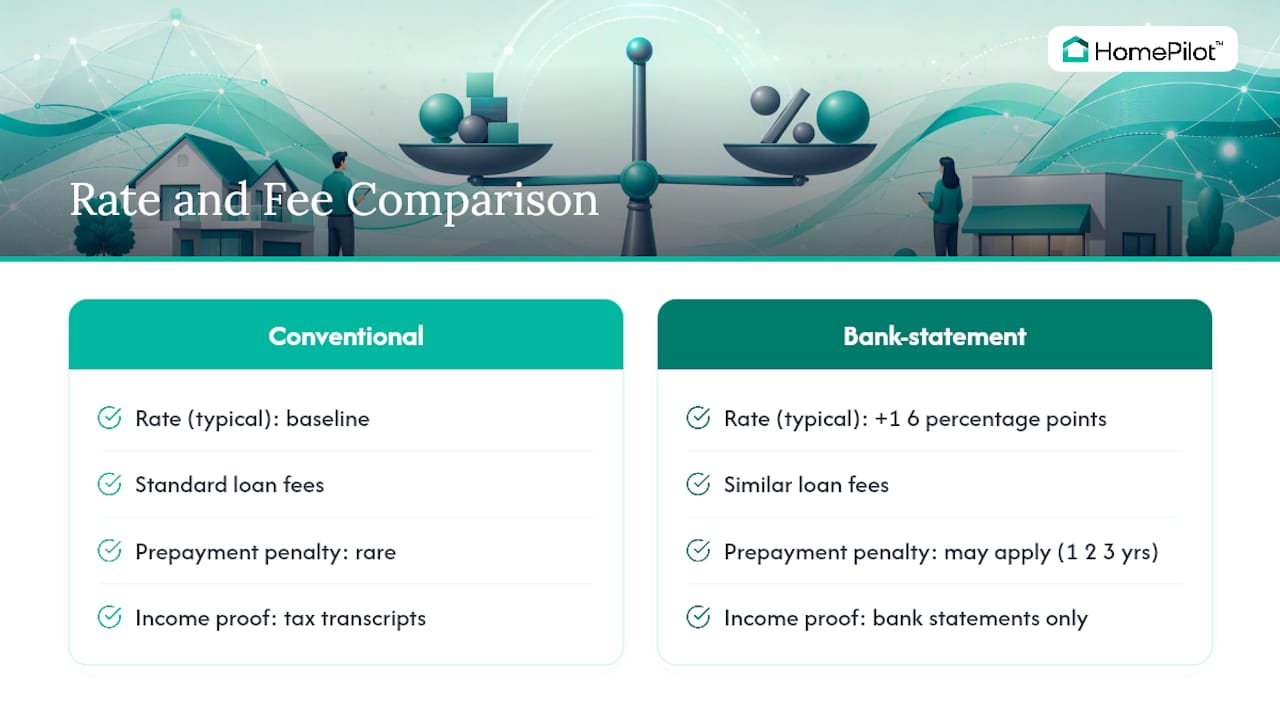
Industry estimates put the typical premium at roughly 1 to 3 percentage points above conventional rates, though your exact number depends on credit score, down payment, reserves, and the specific lender’s risk appetite. That spread reflects the added uncertainty lenders take on when they can’t verify income through tax transcripts, plus the fact that non-QM loans are harder to sell on the secondary market than QM-compliant ones.
Fees run in similar territory to conventional loans in most cases, origination charges, appraisal costs, title fees, but some non-QM products layer on a prepayment penalty, particularly in the first two to three years. Always ask directly whether a specific program carries one before you sign, since it affects your flexibility if you plan to refinance or sell early.
Run the math before committing. A 1.5-point rate difference on a $400,000 loan adds up over 30 years, and it’s worth comparing that cost against simply waiting a year to build a stronger tax-return profile if that’s realistic for your business. A mortgage calculator can turn that abstract rate gap into an actual monthly dollar figure, which makes the decision far easier to weigh honestly.
An Editorial Take on When This Loan Makes Sense
Bank statement loans get treated online as either a rescue plan or a red flag, and both framings miss the point. The honest answer is that they’re a pricing decision. If your tax returns understate your income by enough to shrink your buying power meaningfully, paying a rate premium to access your real cash flow can be the smarter move, not a consolation prize.
Where borrowers get burned is skipping the math. A rate that’s two points higher sounds abstract until you run it against 30 years, and by then some buyers have already signed. Before you commit, look at whether a year of cleaner books and a stronger tax return would qualify you for a cheaper conventional loan instead. Sometimes patience is the better financial strategy. Sometimes it isn’t, and the bank statement route is simply how you get into the house now instead of later.
Jack
Get Matched to Bank Statement Programs Through HomePilot
Finding a lender who actually offers competitive bank statement pricing takes more digging than most self-employed buyers expect, since not every retail bank writes these programs. HomePilot Mortgage gives you a shortcut: instead of calling lender after lender, you get matched against more than 40 lenders and see live wholesale pricing on programs built for non-traditional income, without a hard credit pull or your social security number required just to see a quote.
You can start with the Arizona wholesale rates page to see how live pricing is presented, or check current offers on today’s rates for your situation. If you’ve already got a loan estimate from another lender, HomePilot Mortgage’s free loan estimate review will tell you whether that offer actually reflects wholesale pricing or leaves money on the table. Run your numbers through the mortgage calculators first, then request a quote to see what your specific deposit history and credit profile qualify for.
This article is general information, not a substitute for advice from a qualified financial advisor. Consult a qualified financial professional about your own circumstances before acting on anything here.