CLTV vs LTV: Appraisals, HCLTV, and the 80% Cap That Decides HELOCs
· By the HomePilot team · Reviewed by a licensed loan officer · Company NMLS #2752340

CLTV vs LTV: Appraisals, HCLTV, and the 80% Cap That Decides HELOCs

LTV measures one loan against your home’s value. CLTV adds up every loan secured by the property, including a HELOC, and measures that total against the same value. LTV tells a lender the risk on your first mortgage; CLTV tells them the risk on everything sitting on the house, which is why it drives approval for second liens.
TL;DR:
- Most HELOC lenders cap CLTV around 80% to 90%, and staying within this range generally results in easier approval and better interest rates.
- Appraisal values heavily influence CLTV calculations, with even small drops in home value potentially pushing the ratio above lender thresholds.
- Using the full HELOC credit limit instead of just drawn balances makes it more difficult to secure approval, especially on open lines.
- Borrowers should estimate their CLTV before applying by adding all loan balances and comparing them to the lower of purchase price or appraised value.
- Paying down the first mortgage or requesting a smaller line can significantly improve approval chances by lowering the CLTV ratio.
Table of Contents
- CLTV vs LTV: The Formulas Lenders Actually Use
- Why Lenders Watch CLTV So Closely When Underwriting
- Two Worked Examples: LTV vs CLTV Side by Side
- What CLTV Means for Your HELOC or Second Mortgage Application
- How to Lower Your CLTV Before You Apply
- HCLTV, Drawn Balance, and Occupancy: The Details That Trip People Up
- Why Borrowers Should Estimate CLTV Before They Ever Apply
- Get Your Numbers Checked Before You Commit to a Rate
- Sources
- FAQ
CLTV vs LTV: The Formulas Lenders Actually Use
LTV is simple: your loan balance divided by the property’s value. If your mortgage is $280,000 on a home worth $350,000, your LTV is 80%. Lenders apply this formula to primary mortgages, purchase loans, and standard refinances.
CLTV works differently. It adds your first mortgage balance to any second mortgage or drawn HELOC balance, then divides that sum by the property value, according to Investopedia’s definition. For a purchase, the denominator is whichever is lower: the purchase price or the appraised value. On a refinance, lenders use a fresh appraisal.
A few distinctions matter here:
- LTV looks at a single loan against value.
- CLTV looks at all drawn balances, first mortgage plus seconds, against value.
- HCLTV (high combined loan to value) counts your full HELOC credit limit instead of just what you’ve drawn, which underwriters use when a line is still open and could be maxed out later.
Why Lenders Watch CLTV So Closely When Underwriting
CLTV functions as the primary risk gauge whenever subordinate financing enters the picture, which makes understanding precise property valuation methods and factors critical for both borrowers and lenders. A first mortgage lender gets paid first in foreclosure. A second lien holder gets whatever is left, so lenders treat high combined exposure as a much bigger red flag than a high LTV alone.
Most HELOC and second mortgage lenders cap CLTV somewhere in the 80% to 90% range, and staying under that line usually means an easier approval and a larger available credit limit, according to The Mortgage Reports. LTV, on the other hand, mostly drives mortgage insurance.
When CLTV creeps near a threshold, lenders tend to respond in one of three ways:
- Approve a smaller credit line than requested.
- Price the loan higher to offset the added risk.
- Deny the application outright if the combined balance is too close to the property’s value.
Because subordinate liens carry more foreclosure risk, caps on CLTV are often stricter than the thresholds attached to a standalone first mortgage.
Two Worked Examples: LTV vs CLTV Side by Side
Numbers make this concrete faster than definitions do.
- Purchase with only a first mortgage. You buy a home for $400,000 with a $360,000 loan. LTV is $360,000 ÷ $400,000, or 90%. There’s no second lien, so CLTV equals LTV here.
- Existing mortgage plus a new HELOC. That same home appreciates to $450,000. Your mortgage balance has dropped to $340,000, and you’re applying for a HELOC with a $60,000 draw. CLTV becomes ($340,000 + $60,000) ÷ $450,000, or about 89%. LTV alone, ignoring the HELOC, is only 76%. The gap between those two numbers is exactly why CLTV matters.
- Appraisal comes in low. Say that same house appraises at $420,000 instead of $450,000 once the appraiser visits. CLTV jumps to roughly 95%, likely pushing you past most lenders’ cutoffs even though nothing about your loan balances changed.
What CLTV Means for Your HELOC or Second Mortgage Application
CLTV is usually the number that decides whether a HELOC gets approved at all, and how large a line you get. Fannie Mae’s guidance requires lenders to count your drawn HELOC balance, not just your existing mortgage, when they run this math, and undisclosed subordinate financing can trigger a full re-underwrite of the file, per the Fannie Mae Selling Guide.
Here’s roughly how the bands tend to play out:
- Under 80% CLTV: Usually the smoothest path to approval, often at better pricing.
- 80% to 90% CLTV: Still commonly approvable, but expect closer scrutiny of credit and income, and possibly a smaller line than requested.
- Above 90% CLTV: Many lenders won’t go here at all, or they’ll approve a reduced line to bring you back under their cap.
Pro Tip: *Pull your home’s estimated value before you apply, not after.
Small shifts matter more than people expect. A $10,000 drop in appraised value or an extra $15,000 draw request can move you across a lender’s cutoff line entirely.
How to Lower Your CLTV Before You Apply
- Pay down your first mortgage principal. Every dollar off that balance lowers the numerator directly.
- Request a smaller HELOC amount, or wait. A smaller ask, or a delay until you’ve paid down more principal or secured a higher appraisal, can move you into a better pricing tier.
- Make improvements that support a higher appraised value. Kitchen and bathroom updates, new flooring, and curb appeal fixes tend to move appraisals more than cosmetic touches.
- Work on credit score and debt to income ratio. These don’t change your CLTV math, but they’re the levers underwriters weigh alongside it.
Pro Tip: If you’re within a few points of a lender’s cutoff, ask about a rate and term refinance first. A refinance break-even calculator can show you whether restructuring your first mortgage before adding a HELOC actually saves money.
HCLTV, Drawn Balance, and Occupancy: The Details That Trip People Up
Underwriters sometimes calculate to HCLTV rather than CLTV on an open HELOC, using your full credit limit instead of your current draw, because you could pull the rest of that line at any time after closing. That’s a meaningfully more conservative number than what you’d get using only your drawn balance.
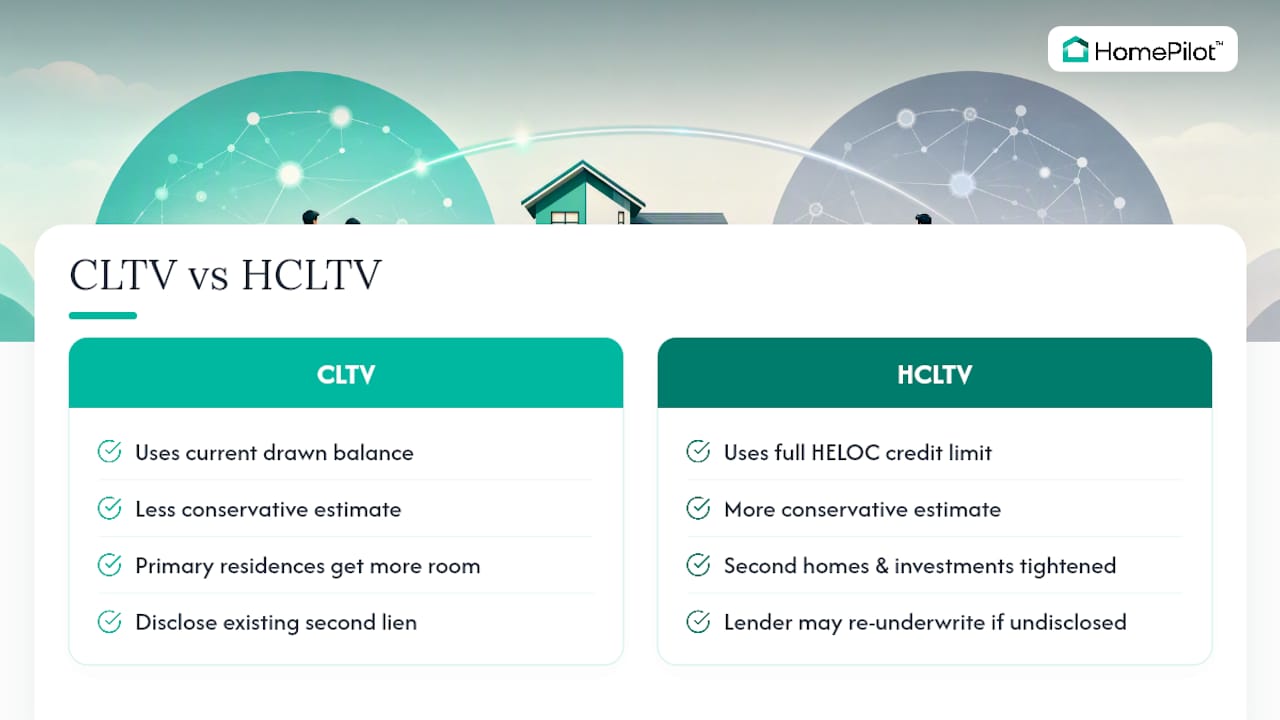
Occupancy type shifts the allowable ceiling too. Primary residences generally get more room under CLTV caps than second homes or investment properties, where lenders tighten both the ratio limits and the reserve requirements.
One more detail that catches borrowers off guard: failing to disclose an existing second lien can force a lender to re-underwrite your file mid-process, according to Fannie Mae’s guidelines. Disclose everything up front.
Why Borrowers Should Estimate CLTV Before They Ever Apply
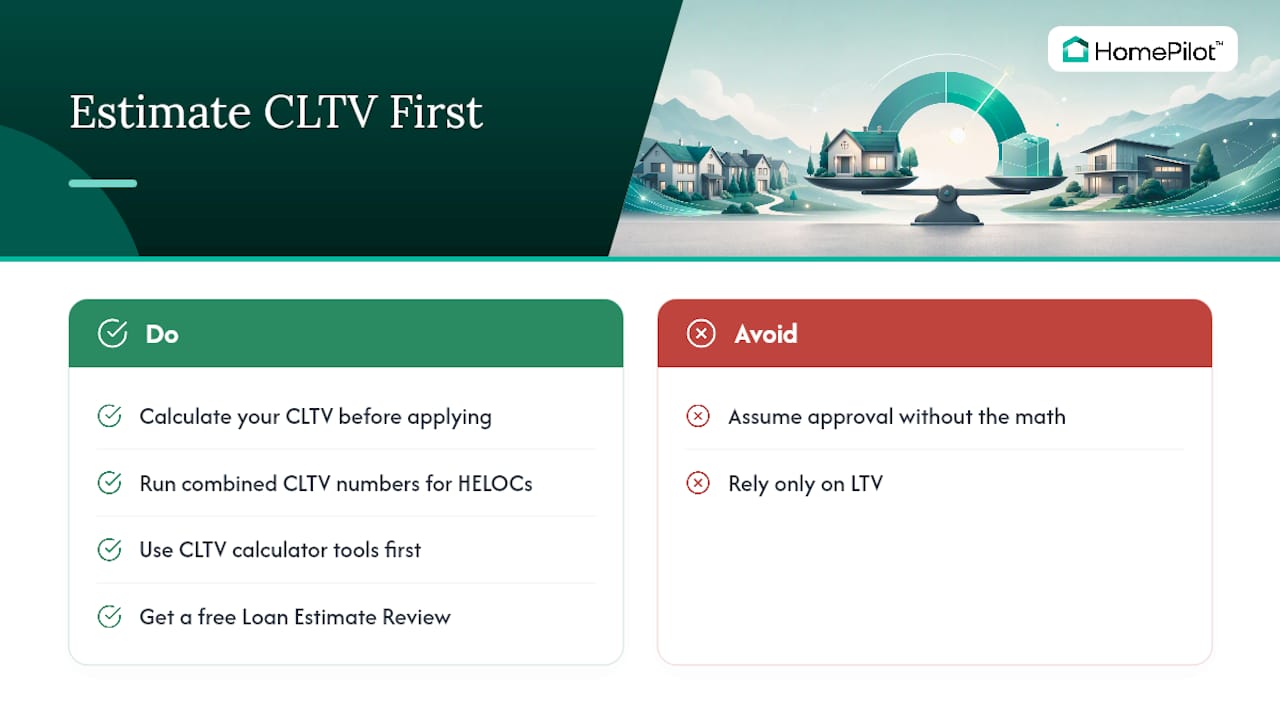
Most people run their LTV in their head without ever thinking about CLTV, and that’s the gap that causes disappointment. If you’re weighing a HELOC, calculate the combined number first, because that’s the figure that actually decides your outcome.
We built our rate comparison and calculator tools around that reality: you should know where you stand before a lender tells you. If you already have a mortgage and you’re shopping for a HELOC or second lien, run your own numbers, then get a free Loan Estimate Review so you know whether the terms you’re being offered actually reflect your CLTV fairly. No guesswork, no assumptions about approval, just the math laid out plainly.
, The HomePilot Team
Get Your Numbers Checked Before You Commit to a Rate
Knowing your CLTV is only half the battle. The other half is making sure the lender pricing that number reflects the best deal available, not just the first offer on the table. HomePilot Mortgage checks your file against 40+ wholesale lenders instead of a single bank’s rate sheet, and every quote comes with $0 lender fees.

We post live wholesale rates next to the national average every business day at HomePilot Mortgage, so you can see exactly where pricing stands before you apply. We also back eligible offers with a $500 Best Price Guarantee, terms apply. If you’re eyeing a HELOC, our Aven partnership gives you wholesale pricing on that product too, and purchases typically close in about 20 days from accepted offer. Start with a free quote or run your numbers through our mortgage calculators first, no hard credit pull required to get started.
Sources
Formulas and definitions draw from Investopedia’s CLTV explainer and the Fannie Mae Selling Guide. HELOC approval thresholds come from The Mortgage Reports. For broader consumer protection context, see HUD.
This article is general information, not a substitute for advice from a qualified financial advisor. Consult a qualified financial professional about your own circumstances before acting on anything here.
- Combined Loan-to-Value Ratio: Definition, Formula, and Insights, Investopedia
- Combined loan-to-value (CLTV) ratios, Fannie Mae Selling Guide
- How combined loan-to-value CLTV impacts HELOC approval, The Mortgage Reports
FAQ
What Does 80% CLTV Mean?
Most lenders treat this as a comfortable line, often with easier approval and better pricing than higher bands.
What Is a Good LTV or CLTV Ratio?
Below 80% is generally considered strong for both ratios, since it usually avoids mortgage insurance on a first mortgage and clears most HELOC lenders’ comfort zone.
How Do I Calculate My CLTV for a Mortgage?
Add your first mortgage balance to any second mortgage or drawn HELOC balance, then divide that total by your home’s current value, using the lesser of purchase price or appraisal on a purchase transaction. HomePilot Mortgage’s calculators can run this math for you in minutes.
Recommended
HomePilot Mortgage, NMLS #2752340, is a licensed mortgage broker in Arizona, California, Colorado, Florida, and Texas. Equal Housing Lender. This article is general information, not a loan offer or a commitment to lend. Rates and program terms change daily and depend on credit, loan amount, and county. HomePilot Mortgage is a private company, not affiliated with or endorsed by the Department of Veterans Affairs, HUD, or any government agency.