Avoid Losing $8,000: Earnest Money vs Down Payment for U.S. Buyers
· By the HomePilot team · Reviewed by a licensed loan officer · Company NMLS #2752340

Earnest money is a small good-faith deposit paid with your offer; a down payment is the much larger sum you pay at closing that reduces your mortgage. Earnest money usually gets applied toward that down payment, but you can lose it entirely if you break contract without a valid contingency. One is a signal to the seller. The other is your equity.
TL;DR:
- Earnest money is typically 1% to 3% of the purchase price and must be deposited within days of offer acceptance to signal seriousness.
- The down payment is paid at closing, usually between 0% and 20%, and directly reduces the mortgage amount, affecting loan terms and monthly payments.
- If contingencies protect the buyer, earnest money is refundable; breaching without valid contingencies can lead to forfeiture of the deposit.
- At closing, earnest money is credited toward the down payment or closing costs, reducing the amount the buyer needs to bring in cash.
- Regional variations exist, with some markets favoring fixed dollar deposits over percentages and different rules on escrow handling and deposit size.
Table of Contents
- What Is Earnest Money?
- What Is a Down Payment?
- Earnest Money vs Down Payment: The Direct Comparison
- How Escrow and Closing Handle Both Payments
- How Much to Expect: Real Dollar Examples
- When You Can Lose Earnest Money
- How to Use Earnest Money Strategically
- Differences in Legal Implications Between Earnest Money and Down Payment
- Common Misconceptions About Earnest Money and Down Payment
- Impact on Mortgage Approval and Loan-to-Value Ratio
- Regional Variations in Earnest Money and Down Payment Practices
- Author Perspective and Quick Takeaways
- How HomePilot Mortgage Helps You Time Your Cash to Close
- Sources
What Is Earnest Money?
Earnest money is a good-faith deposit, sometimes called a “good faith deposit” or “binder,” that you pay when a seller accepts your offer. It tells the seller you’re serious enough to put cash on the line before the deal is final. The money doesn’t go to the seller directly. It sits with a neutral third party, usually a title company, escrow agent, or real estate attorney, until closing or a valid cancellation.
There’s no federal law requiring it, but sellers routinely favor offers that include a solid deposit because it protects them if a buyer walks away for no good reason, according to the National Association of Realtors.
Amounts vary by market, but a few patterns hold across most of the country:
- Commonly 1% to 3% of the purchase price
- Sometimes a flat, fixed dollar amount instead of a percentage
- Higher in competitive markets, lower in slow ones
- Paid by certified check, cashier’s check, or wire transfer, rarely personal check
What Is a Down Payment?
A down payment is the chunk of the purchase price you pay upfront at closing, and it directly shrinks the size of the mortgage you’re borrowing. Lenders treat it as your skin in the game. More money down means less risk for them, and often better loan terms for you.
Unlike earnest money, the down payment amount isn’t negotiated with the seller. It’s set by your loan program and your own financial choices. Zillow’s consumer guidance lays out the range clearly: FHA loans allow as little as 3.5% down, conventional loans typically run 3% to 20%, and VA or USDA loans can eliminate the down payment requirement entirely for eligible borrowers.
The amount you put down also affects your monthly bill in a way earnest money never touches:
- Under 20% down on a conventional loan usually triggers private mortgage insurance (PMI)
- Putting 20% down commonly avoids PMI altogether, per Wikipedia’s overview of down payment mechanics
- Smaller down payments mean a larger loan balance and higher monthly payments
- Down payment funds are separate from closing costs, which cover fees, taxes, and title work
Earnest Money vs Down Payment: The Direct Comparison
Here’s the core distinction stripped down to four points:
- Timing. Earnest money is due within days of your offer being accepted. The down payment is due at closing, often weeks later.
- Purpose. Earnest money signals commitment to the seller. The down payment is collateral for your lender and builds your home equity from day one.
- Refundability. Earnest money is refundable only when your contract’s contingencies protect you; the down payment isn’t “refundable” in that sense because it’s simply your money going into the purchase.
- Net effect. At closing, your earnest deposit is typically credited toward your down payment or closing costs, lowering the total cash you need to bring.
Earnest deposits commonly land in the 1% to 3% range of the purchase price, while down payments run anywhere from 0% to 20%, depending on the loan program. That gap in scale is exactly why buyers sometimes confuse the two. Both are cash you commit to the deal, but one is a fraction of the other, and they arrive at completely different stages of the transaction.
How Escrow and Closing Handle Both Payments
Once you hand over earnest money, it lands in an escrow account managed by a title company, settlement agent, or attorney, not the seller’s pocket. That third party holds the funds under strict instructions until the contract closes or a contingency legitimately cancels the deal, per NAR’s escrow guidance.
At closing, the escrow holder applies your earnest deposit toward your down payment or closing costs, so you write a smaller check for the remaining balance. If the sale falls through because a contingency you’re entitled to kicks in, financing failure or a failed inspection, for example, the funds route back to you. If it falls through because you simply changed your mind, the seller may keep it.
Before you wire a cent, protect yourself:
- Get a signed receipt showing the deposit was received
- Request written escrow instructions spelling out release conditions
- Confirm the holding company’s name and contact information
- Keep copies of every wire confirmation and contract addendum
How Much to Expect: Real Dollar Examples
Numbers make this concrete fast. On a $400,000 home, a 2% earnest deposit is $8,000. That $8,000 typically gets credited at closing, so if you’re putting 10% down ($40,000), you’d only bring the remaining $32,000 plus closing costs to the table, following the math Zillow outlines for buyers.
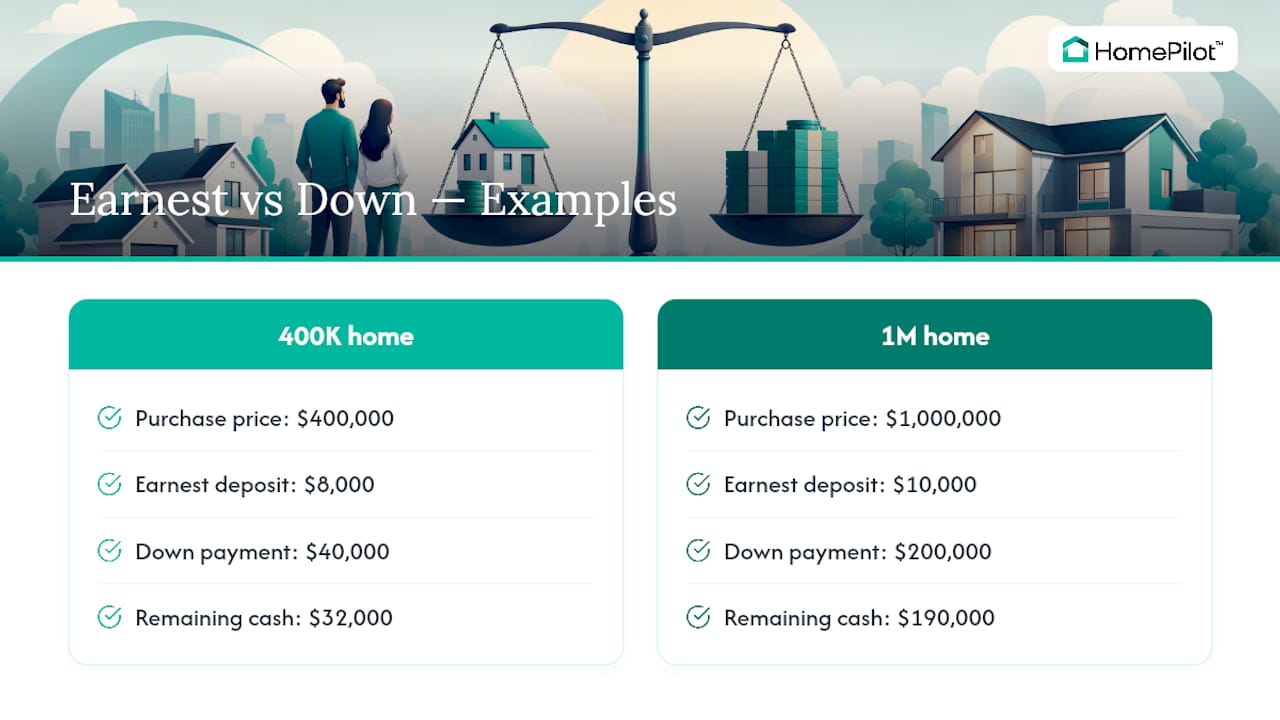
On a $1,000,000 purchase, a 1% earnest deposit runs $10,000, while a 20% down payment is $200,000. That earnest deposit still shaves $10,000 off your remaining cash-to-close.
In competitive bidding situations, sellers sometimes see earnest deposits pushed well above the standard range simply because buyers are trying to look stronger on paper.
When You Can Lose Earnest Money
Contingencies are what keep your deposit safe. The most common ones cover financing, inspection results, appraisal value, clear title, and, less often, the sale of your current home. As long as you exercise these within the deadlines your contract sets, you’re generally entitled to your money back.
Earnest money is refundable only when the contract’s own terms allow it. A buyer who breaches without a valid contingency in place can forfeit the deposit outright, according to Cornell’s Legal Information Institute.
Protect yourself with a few habits:
- Write specific deadlines into every contingency, not vague language
- Submit contingency removal or cancellation notices in writing, always
- Keep timestamped copies of every notice you send
- If a seller claims forfeiture, request the escrow holder’s written justification before agreeing to anything
Pro Tip: Never let a financing contingency expire “informally.” If your lender needs two more days, get a written extension signed by both parties before the deadline passes, not after.
How to Use Earnest Money Strategically
Sizing your deposit isn’t guesswork. It’s a calculated move based on how hot the market is and how much reassurance the seller needs.
- Start with 1% to 3% as your baseline, then adjust based on how many competing offers you expect.
- Pair your earnest deposit with a solid preapproval letter. A preapproval paired with earnest money reassures sellers that financing is likely to close without needing a bigger deposit.
- Confirm the escrow holder’s identity before wiring anything, and get a receipt the same day.
- Track every contingency deadline on a calendar you actually check.
Pro Tip: In a slow market with one offer on the table, there’s rarely a reason to push earnest money above the standard range. Save the aggressive deposit for genuine bidding wars.
Differences in Legal Implications Between Earnest Money and Down Payment
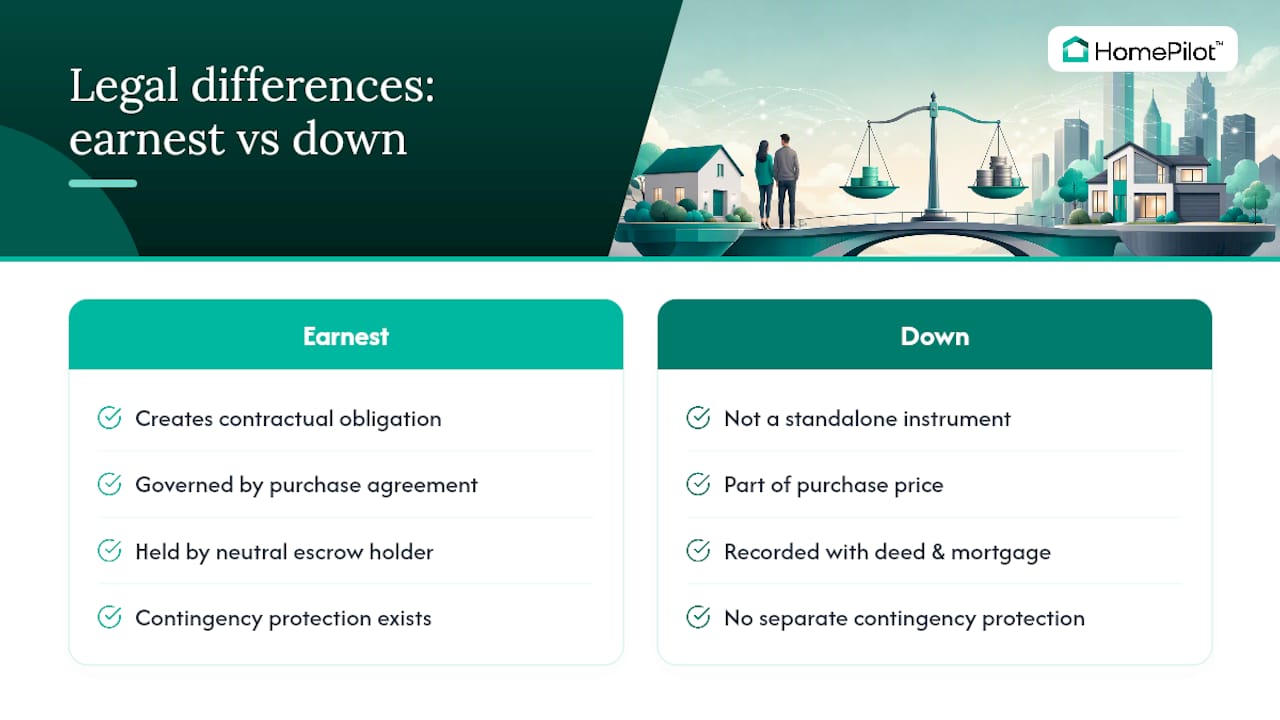
Earnest money creates a contractual obligation the moment it’s deposited. It’s governed by the purchase agreement itself, and disputes over it typically get resolved through the contract’s own dispute-resolution clause, mediation, or small claims court if the amount is modest enough. Because it’s held by a neutral third party rather than paid directly to the seller, the escrow holder has a legal duty to follow the written instructions both parties signed, not the preference of whoever asks loudest.
A down payment, by contrast, isn’t really a standalone legal instrument. It’s simply part of the purchase price, transferred at closing as part of a fully executed deed and mortgage transaction. There’s no separate contingency structure protecting it the way there is for earnest money, because by the time you’re wiring your down payment, the contract’s conditions have already been satisfied and the deal is closing. You’re not risking forfeiture on the down payment the way you are on earnest money, because the transaction is essentially complete.
This distinction matters if a deal goes sideways. If a buyer breaches after depositing earnest money but before the down payment is due, the dispute centers entirely on contract language, contingency deadlines, and escrow instructions. If a problem surfaces after the down payment is paid and the deed has recorded, you’re dealing with property law and title issues, a completely different legal track. Knowing which stage you’re in tells you which set of rules actually applies.
Common Misconceptions About Earnest Money and Down Payment
The biggest misconception is that earnest money and the down payment are the same pool of cash from the start. They’re not. Earnest money is a separate, smaller deposit paid early; it typically becomes part of your down payment later, but only after the deal survives to closing.
Another common mistake: assuming earnest money is always refundable no matter what. It’s refundable only when your contract’s contingencies protect that specific circumstance. Walk away without a valid reason, and the seller may be entitled to keep it.
Buyers also frequently assume a bigger earnest deposit automatically wins a bidding war. It helps, but sellers weigh financing strength, closing timeline, and contingency terms just as heavily. A strong preapproval letter paired with a modest deposit often beats a huge deposit backed by shaky financing.
Some buyers think the down payment amount is negotiable with the seller, the same way earnest money sometimes is. It isn’t. The down payment minimum is set by your loan program (FHA, conventional, VA, USDA), not by back-and-forth negotiation in the purchase contract.
Finally, plenty of buyers assume earnest money always sits with the real estate agent’s brokerage. In most transactions it’s held by a title company, escrow company, or attorney, a neutral party with no financial stake in whether the deal closes.
Impact on Mortgage Approval and Loan-to-Value Ratio
Your down payment size directly sets your loan-to-value ratio, or LTV, the percentage of the home’s value you’re borrowing versus the percentage you’re covering in cash. Lenders use this number to price your interest rate, decide whether PMI applies, and assess overall risk on the loan.
A lower LTV, meaning a bigger down payment, generally unlocks better rate pricing and, on conventional loans, removes the PMI requirement once you cross the 20% threshold, as Wikipedia’s summary of down payment mechanics explains. Underwriters also look at your down payment source to confirm the funds are legitimately yours (or a documented gift), not a hidden loan that would inflate your real debt load.
Earnest money doesn’t factor into LTV calculations at all. Underwriters care about where your down payment funds come from and how long they’ve been in your account, seasoning requirements many lenders apply, but the earnest deposit itself isn’t a separate line item in the approval math. It matters for the purchase contract, not for the mortgage underwriting file.
That said, a buyer who struggles to produce earnest money can raise a small red flag for lenders reviewing overall financial readiness. If you can barely scrape together 1% for a deposit, it’s worth asking whether you’re also stretching to cover your full down payment and closing costs. A mortgage payment calculator can show you exactly how different down payment sizes shift your monthly obligation before you commit to an offer.
Regional Variations in Earnest Money and Down Payment Practices
Earnest money customs shift noticeably depending on where you’re buying. In slower rural or suburban markets, sellers may accept token deposits of a few hundred dollars, since competition is lighter and speed matters less.
Some regions favor fixed-dollar earnest amounts over percentages entirely. The National Association of Realtors notes this shift toward flat-dollar deposits in certain markets, partly because a round number like $10,000 can read as more meaningful to a seller than an abstract percentage buried in the math.
Down payment norms vary less by geography and more by loan program availability, but regional cost differences still shape buyer behavior. If you’re weighing FHA against conventional financing, this comparison of FHA and conventional down payment thresholds breaks down when the lower FHA minimum actually works in your favor.
State-specific escrow rules also differ slightly in who’s licensed to hold earnest funds, attorneys, title companies, or escrow companies, so it’s worth confirming your state’s standard practice with your agent before you wire anything.
Author Perspective and Quick Takeaways
The confusion between these two payments isn’t really about definitions. It’s about timing. Buyers plan their cash-to-close around the down payment and forget earnest money shows up weeks earlier, sometimes catching them short.
Three things to act on now: confirm your escrow holder in writing before wiring anything, size your earnest deposit to the market rather than copying a generic percentage, and run your numbers through a calculator before you write an offer, not after.
Get preapproved and confirm your escrow setup before you’re staring down a deadline.
Jack
How HomePilot Mortgage Helps You Time Your Cash to Close
Users can get a clearer picture of their down payment and cash-to-close before signing a purchase agreement by comparing live wholesale mortgage rates from multiple lenders rather than relying on a single retail bank quote.

HomePilot Mortgage’s mortgage calculators let you model different down payment scenarios side by side, and if you’ve already got a loan estimate in hand from another lender, the free loan estimate review checks it against wholesale pricing to see if you’re overpaying. Start by pulling your live rate comparison so you know your real numbers before your next offer goes in.
Sources
This article is general information, not a substitute for advice from a qualified financial advisor. Consult a qualified financial professional about your own circumstances before acting on anything here.