No Hard Credit Pull: FHA vs Conventional Loans With U.S. Refinance Plan
· By the HomePilot team · Reviewed by a licensed loan officer · Company NMLS #2752340

No Hard Credit Pull: FHA vs Conventional Loans With U.S. Refinance Plan

FHA loans typically suit buyers with lower credit scores or limited cash for a down payment, while conventional loans usually work better for borrowers with stronger credit who want to avoid long-term mortgage insurance. The core tradeoff: FHA makes qualifying easier now, but conventional often costs less over the life of the loan. HomePilot Mortgage can price both programs side by side, with no hard credit pull required for an initial quote.
TL;DR:
- Borrowers with credit scores below 620 generally qualify only for FHA loans, which allow lower scores and smaller down payments.
- FHA charges mortgage insurance premiums that last the life of the loan if the down payment is under 10%, while conventional PMI can be canceled after reaching 80% equity.
- Refinancing from FHA to conventional can eliminate mortgage insurance once 20% equity is achieved, typically within 5 to 8 years.
- HomePilot Mortgage offers side-by-side quotes from 40+ lenders with no hard credit pull, enabling accurate comparison before making a decision.
Table of Contents
- FHA vs Conventional Mortgage: Main Differences at a Glance
- What Lenders Look For and What You’ll Pay at Closing
- FHA MIP vs Conventional PMI: Which Insurance Costs More Over Time?
- Which Loan Should You Pick? A Decision Checklist
- How to Refinance From FHA to Conventional Later
- How HomePilot Mortgage Approaches FHA vs Conventional Decisions
- Get Real FHA and Conventional Quotes Before You Decide
- Sources
- FAQ
FHA vs Conventional Mortgage: Main Differences at a Glance
The two programs split apart on five things: credit, cash to close, insurance rules, loan size, and what you’re allowed to buy.
- Credit score: FHA allows scores as low as 580 with 3.5% down (and sometimes 500 with 10% down), based on HUD’s FHA program overview. Conventional loans typically need a 620 minimum, though the best pricing shows up closer to 740.
- Down payment: FHA starts at 3.5%. Conventional loans can go as low as 3% for qualified first-time buyers, per the CFPB’s breakdown of loan types.
- Mortgage insurance: FHA charges an upfront premium plus a monthly premium (MIP) that can last the life of the loan. Conventional PMI cancels once you build enough equity.
- Loan limits: For 2026, FHA limits run $541,287 in most areas, up to $1,249,125 in high-cost counties. Conforming loan limits, set separately by the Federal Housing Finance Agency, determine where a loan crosses into jumbo territory.
- Property use: FHA loans require the home be your primary residence. Conventional loans can finance a primary home, a second home, or an investment property.
HUD governs FHA rules, appraisal standards, and property eligibility directly. Conventional guidelines come from Fannie Mae and Freddie Mac, but individual lenders add their own layers on top, which is part of why conventional pricing varies so much from one lender to the next.
What Lenders Look For and What You’ll Pay at Closing
Credit score is the first filter, but it’s not the only one. Lenders also weigh your debt-to-income ratio (DTI), how you’re funding your down payment, and how much cash you’ll need on closing day.
- Credit bands: Borrowers under about 620 usually find FHA the more realistic entry point. Borrowers in the mid to high 700s tend to get better long-term value from conventional financing, assuming they can sidestep years of insurance payments, according to Money’s analysis of FHA borrowers.
- DTI expectations: FHA underwriting tolerates higher DTI ratios, sometimes into the 50% range with compensating factors. Conventional lenders generally prefer DTI at or below 45%, though automated underwriting can flex this.
- Gift funds: FHA allows a broader range of gift sources for down payments and closing costs. Conventional loans permit gifts too, but often with tighter documentation on the donor relationship.
- Upfront costs: Expect an appraisal fee, title fees, recording fees, and prepaid items like homeowner’s insurance and property tax escrow on either loan. FHA borrowers can finance the upfront MIP into the loan balance instead of paying it in cash at closing.
Pro Tip: Before you commit to either program, run your numbers through the mortgage calculator to see how the down payment and insurance differences actually change your monthly payment, not just your qualifying odds.
FHA MIP vs Conventional PMI: Which Insurance Costs More Over Time?
Mortgage insurance is where FHA and conventional loans diverge the hardest, and it’s the piece that decides which loan actually costs less by year five or ten.
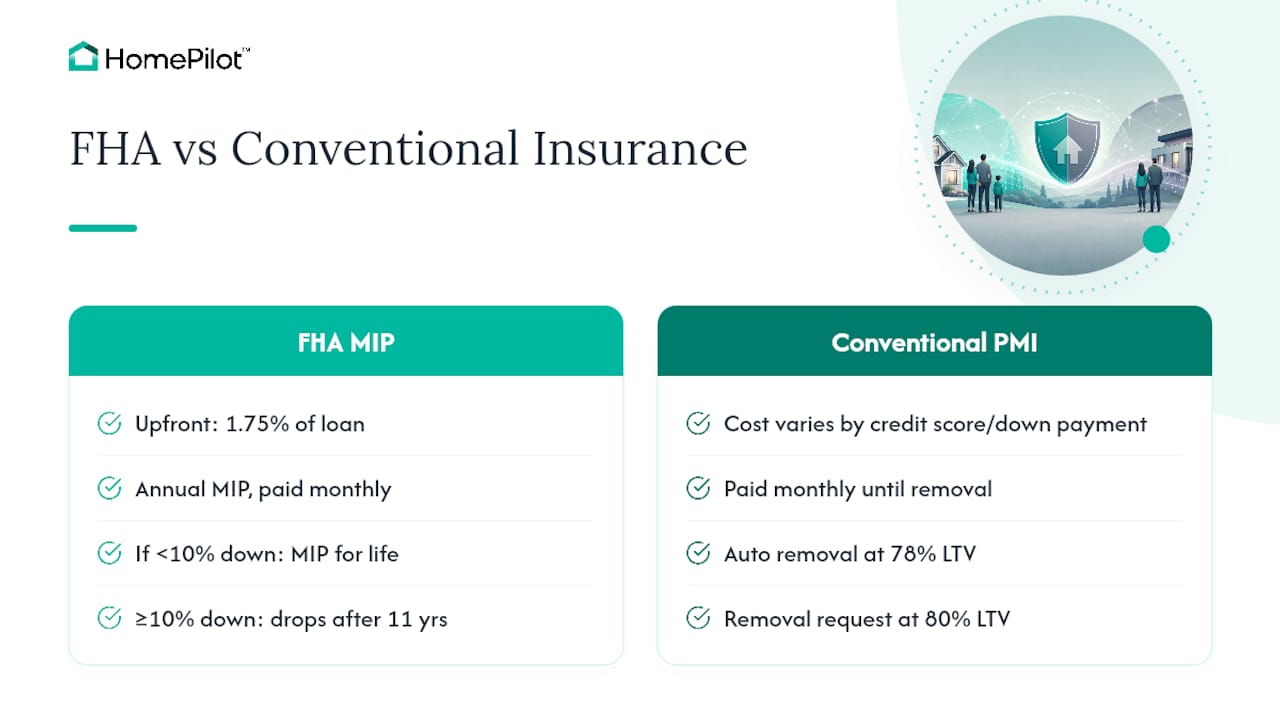
FHA charges an upfront premium (typically 1.75% of the loan amount) plus an annual MIP paid monthly. If your down payment is under 10%, that MIP sticks around for the life of the loan, not just until you reach a certain equity level. Put down 10% or more, and it drops off after 11 years.
Conventional PMI works differently. Cost varies by credit score and down payment, but it disappears automatically once your loan balance hits 78% of the home’s original value, and you can request removal yourself once you reach 80%.
The FHA borrower pays MIP indefinitely unless they refinance. The conventional borrower pays PMI too, but it ends once their balance drops to roughly $273,000, often within 5 to 8 years on a standard amortization schedule. Over a 30-year term, that gap alone can be worth thousands of dollars.
Which Loan Should You Pick? A Decision Checklist
Work through these in order. Most buyers land on an answer by step three.
- Check your credit score first. Below 620, FHA is likely your only realistic path today. Above 700, conventional usually wins on cost.
- Add up your available cash. If 3 to 3.5% down is all you have, both programs are in play, but FHA’s credit flexibility gives you more room if your score is still building.
- Decide your timeline. Planning to sell or refinance within 3 to 5 years? FHA’s easier entry may outweigh its insurance cost, since you won’t carry it long. Staying 10-plus years? Conventional’s cancelable PMI usually wins.
- Confirm the property type. FHA covers manufactured homes and 1 to 4 unit primary residences, but only if you’ll live there. Second homes and investment properties require conventional financing, no exceptions.
- Factor in the market. FHA appraisals carry stricter property condition standards, which can create friction with sellers in competitive bidding situations, according to NerdWallet’s FHA comparison.
How to Refinance From FHA to Conventional Later
Plenty of first-time buyers use FHA to get in the door, then refinance into conventional once their equity and credit catch up. It’s a deliberate two-step strategy, not a backup plan.
- Watch your equity. Once you’re at or above 20% equity, a conventional refinance eliminates monthly mortgage insurance entirely, which is usually the whole point of switching.
- Rebuild your credit. Aim for at least the high 600s before applying. Higher scores unlock better conventional pricing.
- Gather your documents. Expect the same underwriting file as your original purchase: pay stubs, tax returns, bank statements, and a new appraisal.
- Weigh the closing costs. Refinancing isn’t free. Compare what you’d save in monthly MIP against what you’ll pay in new closing costs before pulling the trigger.
Pro Tip: Run a free loan estimate review before signing anything. Comparing your refinance offer against wholesale pricing can reveal whether the timing actually makes sense yet.
How HomePilot Mortgage Approaches FHA vs Conventional Decisions
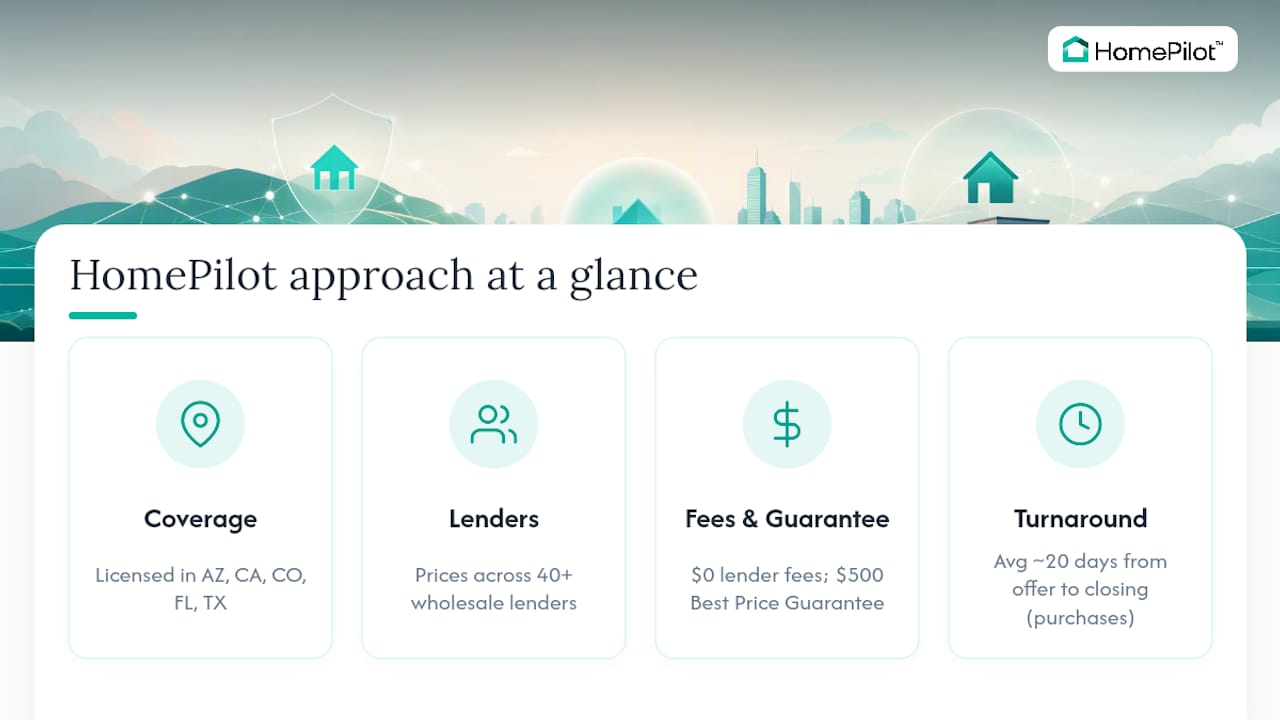
We built HomePilot Mortgage as a family-owned wholesale broker, licensed in Arizona, California, Colorado, Florida, and Texas, because we think borrowers deserve to see real numbers instead of guessing which loan sounds better. We price every file across 40+ wholesale lenders with $0 lender fees, which means an FHA and a conventional quote can sit next to each other in the same conversation, not two separate sales pitches from two separate loan officers.
We publish our live rates beside the national average every business day, back our pricing with a published $500 Best Price Guarantee, and average about 20 days from accepted offer to closing on purchases. If you want to compare FHA and conventional pricing without a hard credit pull, that’s the whole point of starting with us.
, The HomePilot Team
Get Real FHA and Conventional Quotes Before You Decide
Reading about FHA and conventional differences only gets you so far. HomePilot Mortgage is the way to see your actual numbers side by side, not a rate assumption pulled from a national average.

We price your file across 40+ wholesale lenders and pass through the winning pricing with $0 lender fees, backed by a published $500 Best Price Guarantee on eligible offers (terms apply). Check our live wholesale rates against the national average, or start a quick quote with no hard credit pull required. Already have an offer from another lender? Upload it for a free loan estimate review and see how it stacks up against wholesale pricing before you commit. We can’t promise approval or a specific rate, but we can show you exactly where FHA and conventional pricing stand today, for your file, in minutes.
Sources
- CFPB: When can I remove private mortgage insurance (PMI)?
- HUD: Loans and FHA overview
- CFPB: Understand different kinds of loans
- Money: FHA loans and who they’re best for
This article is general information, not a substitute for advice from a qualified financial advisor. Consult a qualified financial professional about your own circumstances before acting on anything here.
FAQ
Is FHA or Conventional Better for a First-Time Buyer?
It depends on your credit score and savings. FHA usually fits first-time buyers with scores under 620 or limited down payment funds, while conventional fits those with stronger credit who want lower long-term costs.
How Long Does FHA Mortgage Insurance Last?
If your down payment is under 10%, FHA’s monthly MIP lasts for the life of the loan. Put down 10% or more, and it ends after 11 years.
When Can I Remove PMI on a Conventional Loan?
You can request removal once your loan balance reaches 80% of your home’s original value, and it cancels automatically at 78%, per CFPB guidance.
What Are the 2026 FHA Loan Limits?
FHA limits are $541,287 in most areas for 2026, rising to $1,249,125 in high-cost counties, based on figures reported by Money.
Can I Compare FHA and Conventional Quotes Without a Hard Credit Check?
Yes. HomePilot Mortgage provides initial FHA and conventional quotes with no hard credit pull, so you can compare pricing before deciding which program to pursue.
Recommended
HomePilot Mortgage, NMLS #2752340, is a licensed mortgage broker in Arizona, California, Colorado, Florida, and Texas. Equal Housing Lender. This article is general information, not a loan offer or a commitment to lend. Rates and program terms change daily and depend on credit, loan amount, and county. HomePilot Mortgage is a private company, not affiliated with or endorsed by the Department of Veterans Affairs, HUD, or any government agency.