Avoid Losing Your Deposit: Florida Condo Financing After 2026 Rules
· By the HomePilot team · Reviewed by a licensed loan officer · Company NMLS #2752340
Yes, you can still finance a condo in Florida, but the loan approval now hinges on the building, not just your credit score. The single move that saves buyers the most heartache is requesting the HOA’s financial documents and running the building through Fannie Mae’s Condo Status Finder before writing an offer. Skip that step and you risk falling for a unit that no conventional, FHA, or VA lender will touch.
TL;DR:
- Most Florida condos now require full project approval with documented reserve funding, inspections, and litigation status before lenders will approve financing.
- Conventional loans are only available for warrantable buildings that meet Fannie Mae and Freddie Mac standards, while non-warrantable projects lead to higher costs and alternative loan options.
- Buyers should verify a project’s status early by requesting HOA documents and running official eligibility checks through Fannie Mae, HUD, and VA databases to avoid last-minute surprises.
- Lower down payments are possible only on warrantable condos, while non-warrantable buildings often require 20% or more and may only qualify for portfolio or FHA financing.
- Handling project-specific issues like underfunded reserves, pending litigation, or excessive short-term rentals early can prevent delays or denials during the approval process.
Table of Contents
- Why Florida Condo Financing Works Differently Than a House Loan
- Which Loan Programs Can Finance a Florida Condo
- How Do You Check If a Condo Project Is Warrantable?
- What Do Borrowers Need to Qualify for a Florida Condo Mortgage
- How the 2026 GSE Updates Change Florida Condo Approvals
- Can You Refinance or Get a HELOC on a Florida Condo
- Your Step-by-Step Path From Offer to Closing
- How HomePilot Mortgage Supports Florida Condo Buyers
- What I’d Tell Any Florida Condo Buyer Right Now
- Get a Fast Florida Condo Financing Quote From HomePilot
- Where to Verify Condo Eligibility and Lender Credentials
- Sources
Why Florida Condo Financing Works Differently Than a House Loan
A house loan looks at you. A condo loan looks at you and the entire building you’re buying into. Lenders call this project-level underwriting, and it’s the reason two buyers with identical credit profiles can get wildly different outcomes depending on which building they choose.
The industry term for a building that passes this review is “warrantable.” A warrantable condo meets Fannie Mae and Freddie Mac’s standards for owner-occupancy ratios, insurance coverage, reserve funding, and litigation history. Clear those hurdles and you unlock conventional financing at the best available rates. Miss even one, and the project drops into non-warrantable territory, where financing gets more expensive and harder to find.
Florida adds a layer most other states don’t deal with at this scale. After the Champlain Towers South collapse in Surfside, the state passed SB-4D, which requires milestone structural inspections for buildings three stories or taller and mandates fully funded reserve accounts for major repairs. Lenders took notice. Coverage from the Miami Herald has tracked how underwriters now scrutinize Florida buildings more aggressively than comparable properties in other states, pulling reserve studies and inspection reports that used to get a lighter look.
The practical fallout breaks down into a few common scenarios:
- A 1970s beachfront condo fails its milestone inspection and can’t get full financing until repairs are funded and documented.
- A small HOA with underfunded reserves triggers a lender’s automatic denial, regardless of the buyer’s finances.
- A building with pending litigation over construction defects becomes ineligible for conventional loans until the case resolves.
- A high concentration of short-term rentals or investor-owned units pushes a project below the owner-occupancy threshold lenders require.
None of this means the building is unlivable or a bad investment. It means the financing path narrows, and buyers who don’t know this going in often lose their earnest money or their closing date.
Which Loan Programs Can Finance a Florida Condo
Once you know a project’s warrantability status, the loan program almost picks itself. Here’s how the main options stack up.
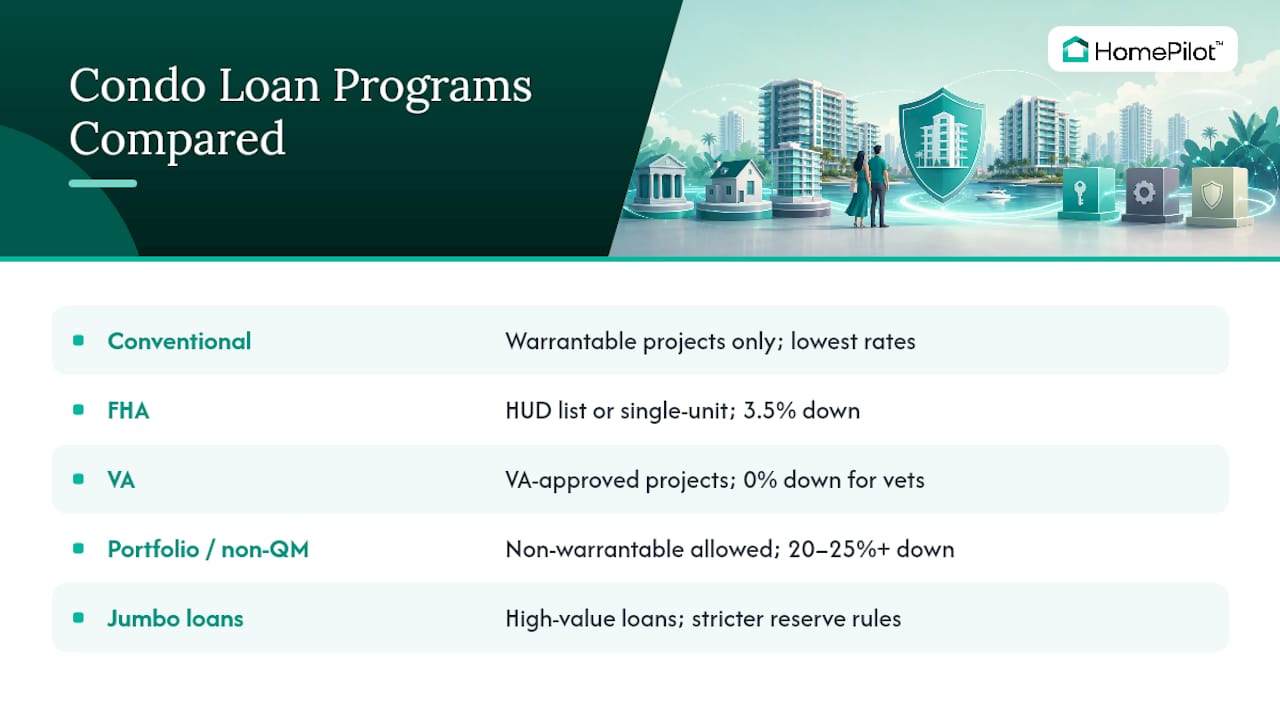
Conventional loans (Fannie Mae/Freddie Mac): These offer the lowest rates and the most flexible terms, but only for warrantable projects. Most buyers should start here and only branch out if the building doesn’t qualify.
FHA loans: The Department of Housing and Urban Development maintains its own approved condo list, separate from Fannie Mae’s. FHA also allows single-unit approvals in some cases, meaning a specific unit can qualify even if the whole complex hasn’t been formally reviewed. Down payments run as low as 3.5%, but the project still has to clear HUD insurance and reserve requirements.
VA loans: Veterans and active-duty service members get access to VA-approved condo projects, with zero down payment for qualifying buyers. The VA keeps its own separate registry, and a building being FHA-approved doesn’t automatically mean it’s VA-approved, or vice versa.
Portfolio and non-QM loans: When a project fails warrantability, this is usually where buyers land. Portfolio lenders keep the loan on their own books instead of selling it to Fannie or Freddie, which lets them set their own rules. Expect higher costs and larger down payment requirements, often 20% to 25% or more, along with higher interest rates than a conventional loan would carry.
Jumbo loans and cash: For high-value units above conforming loan limits, jumbo financing follows similar project-review logic but with stricter reserve requirements for the borrower. Some buyers in contested buildings simply pay cash to avoid the review process entirely, then refinance later if the project’s status improves.
A non-warrantable label isn’t a financing dead end. Portfolio lenders and FHA single-unit approvals routinely close deals on buildings that conventional underwriters won’t touch, just at a different price point.
How Do You Check If a Condo Project Is Warrantable?
Before you fall in love with a unit, verify the building. Here’s the sequence that actually works:
- Ask the listing agent or HOA for the condo questionnaire package. This includes the operating budget, reserve study, master insurance certificate, litigation disclosures, and recent meeting minutes.
- Run the property through Fannie Mae’s Condo Status Finder. HOAs, management companies, and authorized advisors can check a project’s eligibility status and see documented reasons a building may be ineligible.
- Check HUD’s FHA-approved condo list and the VA’s condo approval database separately if you’re using either program. Approval on one list doesn’t guarantee approval on the other.
- Review the reserve study for funding percentage. Anything significantly underfunded is a red flag lenders will catch even if you don’t.
- Ask directly about pending litigation, insurance lapses, and short-term rental percentages. These three items sink more condo loans than any other factor.
Common red flags include a master insurance policy that lapsed or shrank after a rate hike, litigation tied to construction defects or storm damage, a failed or overdue SIRS (Structural Integrity Reserve Study) inspection, and short-term rental activity above what the loan program allows.
Pro Tip: Ask your lender to pull the project’s status before you submit an offer, not after. Some lenders can run a quick preliminary check within a day, and that single phone call can save you from a 60-day contract that collapses at the finish line.

Build a financing contingency and an HOA-document contingency into your offer. If the seller or their agent resists sharing the condo questionnaire before contract, that hesitation is itself worth noting.
What Do Borrowers Need to Qualify for a Florida Condo Mortgage
Your personal financial profile still matters, and condo loans often carry stricter overlays than a comparable house loan.
- Down payment: Conventional loans on warrantable condos can start around 5% to 10% for well-qualified buyers, while non-warrantable projects frequently push that to 20% or more.
- Credit score: Many lenders set a higher minimum for condos than for single-family homes, particularly when the project itself carries any risk flags.
- Debt-to-income ratio: Underwriters weigh your DTI against the building’s financial health, so a marginal debt profile combined with a marginal HOA can tip a loan into denial.
- HOA reserves and special assessments: A building hit with a large special assessment, common after a failed inspection, can affect your qualifying ratios even if the assessment doesn’t apply to you personally yet.
- Occupancy and investor restrictions: Second-home and investment-property purchases usually require larger down payments than owner-occupied units, and some programs cap how many units in a building can be non-owner-occupied.
An HOA with two years of reserve contributions on the books signals stability to an underwriter. An HOA that just voted a $40,000 special assessment for roof repairs signals the opposite, and your loan officer will ask about it either way.
How the 2026 GSE Updates Change Florida Condo Approvals
The biggest shift heading into 2026 involves how much scrutiny a project gets before a loan closes. Legal and industry summaries report that updated GSE guidelines eliminate limited reviews for many condo loans, pushing more transactions into full project reviews with heavier documentation and reserve-verification requirements.
Practically, that means:
- Buildings that used to qualify under a quick, lighter-touch review now face the same scrutiny as complex or previously flagged projects.
- Lenders are requesting more from HOAs upfront, including detailed reserve studies and insurance documentation that some smaller associations aren’t used to producing quickly.
- Underwriting timelines are stretching as lenders wait on complete HOA paperwork before clearing loans to close.
Layer Florida’s SB-4D structural inspection deadlines on top of this, and buildings still catching up on milestone inspections face a double bottleneck: state compliance timelines colliding with tighter federal loan-review standards. Buyers should build extra time into closing schedules and request HOA documents the day they go under contract, not the week before closing.
The upside for buyers who prepare early: full reviews that used to feel like a bottleneck are becoming standard practice, and lenders who specialize in Florida condos are getting faster at processing them.
Can You Refinance or Get a HELOC on a Florida Condo
Warrantability doesn’t stop mattering once you own the unit. It follows you into refinancing and home equity decisions too.
If your building’s status changed since you bought, say it lost warrantable status after a failed inspection or a new litigation filing, your refinance options narrow the same way a purchase loan’s would. Rate-and-term refinances on warrantable projects still move through conventional channels with minimal friction. Cash-out refinances face tighter scrutiny industry-wide, and a shaky HOA can make that scrutiny sharper.
Home equity lines of credit remain available for many condo owners, though HELOC programs often carry their own project-eligibility checks separate from a first mortgage. Some lenders that will refinance your first loan won’t extend a HELOC on the same building if the reserve study looks thin.
Before you apply for either, gather:
- Current HOA financial statements and the latest reserve study
- Proof of active master insurance coverage
- Any special assessment notices issued in the past two years
- Recent HOA meeting minutes, especially any mentioning litigation or structural concerns
Owners who keep this file updated year over year, rather than scrambling for it at refinance time, close faster and avoid the surprise denials that catch people who assumed their original approval still applied.
Your Step-by-Step Path From Offer to Closing
- Pre-qualify with a lender who actually handles condo files regularly. Not every loan officer works condo deals often enough to spot red flags fast.
- Request HOA documents and run the official status checks through Fannie Mae’s tool and, if relevant, HUD’s or the VA’s condo databases.
- Write financing and HOA-document contingencies into your offer, giving yourself an exit if the building’s paperwork reveals a problem.
- Send your lender everything the moment you get it. Operating budgets, reserve studies, insurance certificates, and litigation disclosures all speed up or slow down underwriting depending on how fast they land on the underwriter’s desk.
- Ask early about any pending SIRS or milestone inspection deadlines. A building mid-inspection can delay your closing by weeks even if everything else checks out.
Most condo questionnaires take HOAs anywhere from a few days to two or three weeks to produce, depending on whether their management company has the file ready. Build that turnaround into your contract timeline instead of assuming a quick response. If the seller’s side stalls on providing documents past your contingency deadline, that’s your cue to extend the deadline in writing or walk before you lose your deposit.
How HomePilot Mortgage Supports Florida Condo Buyers
Condo files take extra legwork, and having a broker who already knows the drill matters more here than on a standard house purchase. HomePilot gives Florida buyers direct access to wholesale mortgage rates and matches borrowers with more than 40 lenders, which matters a lot when one lender rejects a project and another approves the same building without hesitation.
Getting a quote takes about three minutes and doesn’t require a Social Security number or a hard credit pull upfront, so you can shop rates before committing to a lender who might not even work condo files well.
HomePilot fits particularly well when:
- Your building has a complicated status and you need a broker who can shop it across multiple lenders instead of getting one denial and giving up
- You’re refinancing or pulling cash out and want to compare wholesale pricing against what a bank quoted you
- You want someone reviewing your loan estimate line by line before you sign anything
Have your HOA questionnaire and reserve study ready when you reach out. It shortens the process considerably.
What I’d Tell Any Florida Condo Buyer Right Now
The biggest mistake I see isn’t a credit problem or a down payment shortfall. It’s buyers falling for a unit before anyone checks the building. Three red flags deserve immediate attention: an underfunded reserve account, any pending litigation, and a short-term rental percentage that’s crept higher than the HOA bylaws admit.
Address all three by asking for documents on day one of your search, not after you’ve written an offer. A five-minute phone call to the HOA management company can save you a month of wasted underwriting.
Talk to your lender and the HOA in the same week you find a unit you’re serious about. Waiting until after contract signing to ask basic questions is how deals fall apart at the closing table. If you want a broker who already knows how to navigate a Florida condo file, HomePilot is built for exactly that conversation, and the CFPB’s home loan toolkit is worth a read before you sign anything.
Jack
Get a Fast Florida Condo Financing Quote From HomePilot
HomePilot is the alternative to shopping bank by bank for a Florida condo loan: one application surfaces wholesale pricing across more than 40 lenders, so a rejection on a tricky building at one shop doesn’t end your search.
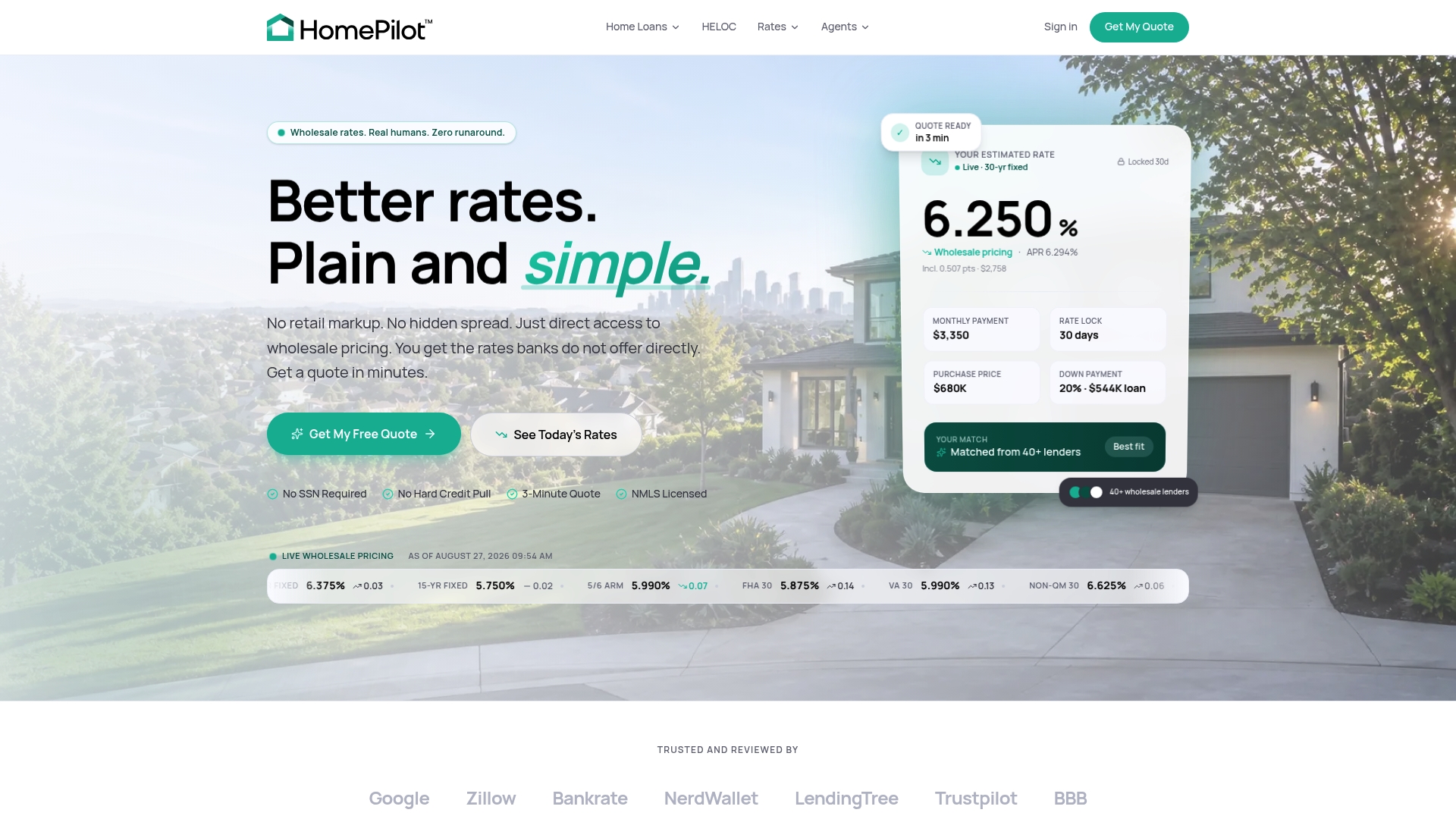
Here’s what speeds things up. Have your HOA questionnaire, reserve study, and master insurance certificate ready before you request a quote. HomePilot’s team already knows which lenders in its network are comfortable with non-warrantable projects and which specialize in straightforward conventional deals, so your file goes to the right match instead of getting stuck with a lender unfamiliar with condo underwriting. Quotes take about three minutes, with no Social Security number or hard credit pull required to see where you stand.
Whether you’re buying your first Florida condo, refinancing, or pulling equity out of one you already own, start with the Florida mortgage broker page to see live wholesale rates and get matched with a lender suited to your building’s status.
Where to Verify Condo Eligibility and Lender Credentials
Check a project’s standing directly through Fannie Mae’s Condo Status Finder, and cross-reference FHA and VA approval lists separately for those programs. Before working with any broker or lender, confirm their registration through NMLS Consumer Access. These tools take a few minutes and catch problems no listing description will mention.
This article is general information, not a substitute for advice from a qualified financial advisor. Consult a qualified financial professional about your own circumstances before acting on anything here.