5 Steps to Close a Gift of Equity for U.S. Families
· By the HomePilot team · Reviewed by a licensed loan officer · Company NMLS #2752340

A gift of equity happens when a seller sells a home to a family member below fair market value, and the difference between that value and the sale price counts as the buyer’s down payment right on the Closing Disclosure. No cash changes hands. The lender still requires an independent appraisal, a signed gift letter, and, depending on the amount, the donor may need to file IRS Form 709. Get those three pieces right and the deal moves like any other closing.
TL;DR:
- The gift of equity is treated by lenders as a credit to the buyer, directly reducing the required down payment and loan amount on the settlement statement.
- An appraisal must be ordered before finalizing the sale price to accurately establish fair market value, which determines the gift size and eligibility.
- Proper documentation, including a signed gift letter, matching appraisal, and settlement statement, is crucial to prevent delays and ensure smooth underwriting.
- Different loan programs impose unique rules on gift of equity transactions, affecting eligibility, gift limits, and how credits apply to closing costs.
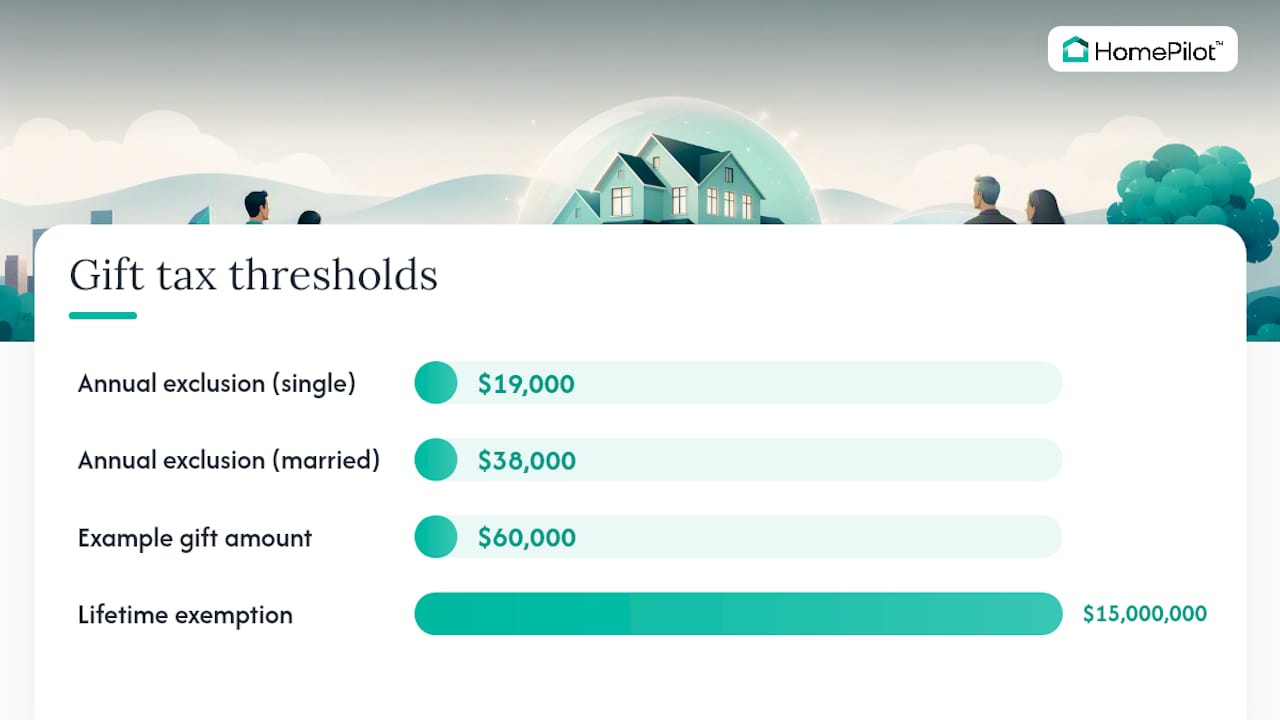
- The IRS considers gift of equity amounts above $19,000 per donor to the same recipient taxable, requiring Form 709 reporting, but most families do not owe actual taxes due to the $15 million lifetime exemption.
Table of Contents
- What Is a Gift of Equity, and How Do Lenders Treat It?
- How Does the Gift of Equity Process Work Step by Step?
- Do FHA, VA, USDA, and Conventional Loans Handle Gift of Equity Differently?
- What Documents Do You Need for a Gift of Equity?
- What Are the Tax Implications of a Gift of Equity?
- Is a Gift of Equity a Good Idea for Buyers and Sellers?
- How Do You Calculate a Gift of Equity?
- What Mistakes Delay or Kill a Gift of Equity Closing?
- How a Mortgage Broker Helps With a Gift-of-Equity Purchase
- What the Research Actually Tells Buyers and Sellers to Prioritize
- Ready to Move Forward With a Gift of Equity Purchase?
- Where This Information Comes From
- Sources
What Is a Gift of Equity, and How Do Lenders Treat It?
The math is simple even when the paperwork isn’t. A licensed appraiser sets the home’s fair market value, the family agrees on a sale price below that value, and the gap between the two numbers becomes the gift. Sell a home appraised at a certain fair market value for a lower agreed price, and the difference becomes the gifted equity with no wire transfer required.
Lenders don’t treat this as a discount or a favor. They treat it as capital the buyer already has in the deal, the same as if the buyer had wired $60,000 into escrow. That’s the part people miss: the seller never touches that money, and the buyer never has to prove they saved it. The gift shows up as a credit on the Closing Disclosure, reducing the amount the buyer needs to bring to the table and, in many cases, shrinking or eliminating the loan amount needed to close.
A few mechanics matter here:
- The appraisal, not the tax assessment or a Zillow estimate, establishes fair market value for underwriting purposes.
- The gift amount is the appraised value minus the negotiated sale price, calculated at the appraisal date, not at contract signing.
- Underwriters verify the math themselves; they don’t take the family’s word for the numbers.
- The credit appears as a line item, usually labeled a gift of equity, on the settlement statement that both seller and buyer sign.
Because no funds move, there’s no bank statement to trace, no seasoning period to wait through, and no “large deposit” letter to write. That’s the single biggest operational advantage over a cash gift, and it’s why family sales close faster once the appraisal and gift letter are in hand.
How Does the Gift of Equity Process Work Step by Step?
Sequencing matters more in a gift-of-equity deal than in a standard purchase, because three separate parties, the lender, the appraiser, and the title company, all need matching numbers before anyone signs anything.
- Call the lender first, before signing a contract. Disclose upfront that this is a non-arm’s-length sale between relatives. Lenders classify these transactions differently, and hiding the relationship is the fastest way to blow up a closing later.
- Order a professional appraisal. This has to happen before you finalize the sale price, since the appraisal is what defines fair market value and, therefore, the size of the gift.
- Draft and sign a gift of equity letter. It needs the donor’s name, the relationship to the buyer, the exact dollar amount, and a clear statement that no repayment is expected.
- Get the gift itemized on the settlement statement. The closing agent lists it as a credit, and underwriting will match that figure against the appraisal and the letter.
- Coordinate timing. Appraisal, loan underwriting, and the closing date all need to line up, since a stale appraisal or a mismatched gift letter can push the closing back weeks.
Pro Tip: Order the appraisal before you lock in a sale price with your relative. Families often agree on a number first, then discover the appraisal comes in lower, forcing an awkward renegotiation right before closing.
Do FHA, VA, USDA, and Conventional Loans Handle Gift of Equity Differently?
Program rules diverge here, and the differences aren’t cosmetic. They change who can give the gift, how much reserve cash you need, and whether the gift can touch closing costs at all.
- Conventional loans (Fannie Mae and Freddie Mac): Fannie Mae permits gifts of equity for both primary residences and second homes, provided the donor meets eligibility rules and the transaction is properly documented. One catch buyers overlook: a gift of equity cannot be used to satisfy post-closing reserve requirements, so if your loan program demands two months of mortgage payments in reserve, that cash has to come from somewhere other than the gift.
- FHA loans: HUD guidance requires additional documentation for non-arm’s-length transactions, and the seller must qualify as an eligible donor under FHA’s family-relationship definitions. Some scenarios trigger minimum gift percentages, so FHA borrowers should confirm eligibility with a lender before assuming the deal qualifies the same way a conventional loan would.
- VA loans: The VA applies its own restrictions on how credits interact with closing costs, and a gift of equity is generally treated as reducing the purchase price rather than functioning as a cash-back credit at the table. Veterans should ask their lender specifically how the VA appraisal and funding fee interact with a family sale.
- USDA loans: USDA rural housing loans apply similar non-arm’s-length scrutiny, with income and property eligibility layered on top of the standard gift documentation.
Every program shares three underwriting checks: confirming the family relationship, matching the gift amount to the appraisal, and making sure the buyer never receives cash back beyond what’s needed to close. Cross any of those lines and underwriting stalls.
What Documents Do You Need for a Gift of Equity?
Assemble this file before you’re deep into underwriting, because missing paperwork is the number one reason gift-of-equity closings slip past their original date.
- Independent appraisal report establishing fair market value, dated close to the closing timeline.
- Signed gift letter naming the donor, stating the relationship to the buyer, listing the exact dollar amount, and confirming no repayment is expected.
- Closing Disclosure or settlement statement itemizing the gift as a distinct credit line.
- Seller mortgage payoff statement, confirming any existing loan balance is covered by sale proceeds.
- Proof of ownership and identification for the donor, plus trust or estate documents if the property sits inside either.
Underwriters cross-check every figure across these documents. If the gift letter says $60,000 but the settlement statement lists $55,000, that five-thousand-dollar gap gets flagged and someone has to explain it before the loan clears to close. Matching numbers across every document is the difference between a same-week resolution and a two-week delay.
What Are the Tax Implications of a Gift of Equity?
The IRS treats a gift of equity exactly like a cash gift for reporting purposes, which surprises a lot of families who assume that because no money moved, no tax rules apply.
For tax year 2026, the IRS sets the annual gift tax exclusion at $19,000 per donor, per recipient, or $38,000 if a married couple gives jointly to the same buyer. Gift a buyer $60,000 in equity as a single parent, and $41,000 of that exceeds the exclusion, triggering a requirement to file Form 709. Filing doesn’t mean paying, though.
By the numbers: The 2026 lifetime gift tax exemption sits at $15,000,000, which is why most donors report the excess on Form 709 and never actually owe tax. The exclusion just tracks against that lifetime total.
The donor, not the buyer, is generally responsible for any gift tax liability, though in practice most families never write a check to the IRS over this. The bigger tax consequence often lands on the buyer years later: the buyer’s cost basis equals the purchase price actually paid, not the home’s appraised value. That lower basis means a bigger taxable gain if the buyer sells down the road, since the “gifted” portion of the home’s value never gets added to their cost basis.
Pro Tip: If the donor is older or might need long-term care within a state’s Medicaid lookback window, get a CPA or elder-law attorney involved before signing anything. Large equity transfers can trigger Medicaid penalty periods calculated by dividing the gift’s value by the state’s average monthly care cost.
State-level gift and estate tax rules vary too, so don’t assume federal numbers tell the whole story. A quick call to a CPA before closing costs a lot less than untangling a filing mistake afterward.
Is a Gift of Equity a Good Idea for Buyers and Sellers?
The trade-offs run in opposite directions for each side of the table, and both parties should walk in knowing exactly what they’re giving up or gaining.
- Buyer upside: instant down payment credit, a smaller loan amount, and often enough equity to clear the 20% threshold that eliminates private mortgage insurance entirely.
- Seller trade-off: less cash in hand at closing, since the “sale price” is deliberately below market value, plus the gift-tax reporting obligation discussed above.
- Capital gains shift: the buyer inherits a lower cost basis than the home’s true value, which can mean a larger taxable gain whenever they eventually sell.
- Estate planning angle: for older sellers, gifting equity now instead of leaving the home through a will can simplify inheritance, but it’s worth running past an estate attorney first.
A gift of equity makes the most sense when a family wants to keep a home in the family rather than sell it on the open market and split proceeds. It makes less sense when the seller needs the cash from the sale to fund their own next move.
How Do You Calculate a Gift of Equity?
Run the numbers before you fall in love with a price, because the math determines both your down payment percentage and whether PMI enters the picture at all.
- Start with the appraised value. Say the home appraises at $350,000.
- Subtract the agreed sale price. The family agrees to sell for $280,000, so the gift of equity equals $70,000.
- Calculate the effective down payment. That $70,000 gift against a $350,000 appraised value works out to 20% down, often enough to avoid private mortgage insurance on a conventional loan.
- Check the loan amount. The buyer only needs financing for $280,000, since the gift already covers the rest of the value gap.
If the appraisal comes back lower than the negotiated sale price, the gift shrinks automatically, and the family has to either renegotiate the price, have the buyer bring extra cash, or order a second appraisal. Run a few scenarios through a mortgage calculator before locking in a number with your relative.
What Mistakes Delay or Kill a Gift of Equity Closing?
Most of the problems that surface in these deals trace back to a mismatch somewhere in the paperwork or a misunderstanding about how much equity actually exists to give.
- Appraisal shortfalls: if the appraised value lands lower than expected, the gift amount drops with it, sometimes below what the buyer needs for the down payment they were counting on.
- Insufficient seller equity: a donor can’t gift more than they actually own; if the seller still owes $200,000 on a home worth $350,000, that payoff comes out of sale proceeds first.
- Cash-back red flags: underwriters watch closely for situations where the buyer ends up with money in hand at closing beyond what the loan program allows.
- Document mismatches: the fastest way to stall underwriting is a gift letter, appraisal, and settlement statement that don’t tell the exact same dollar-for-dollar story.
How a Mortgage Broker Helps With a Gift-of-Equity Purchase
A broker’s job in these deals is matching, not guessing. Not every lender handles non-arm’s-length sales the same way, and finding one that’s comfortable with your specific loan program, whether that’s conventional, FHA, VA, or USDA, saves weeks of back-and-forth. HomePilot Mortgage compares live wholesale pricing across more than 40 lenders and can flag which ones are set up to process family transactions smoothly.
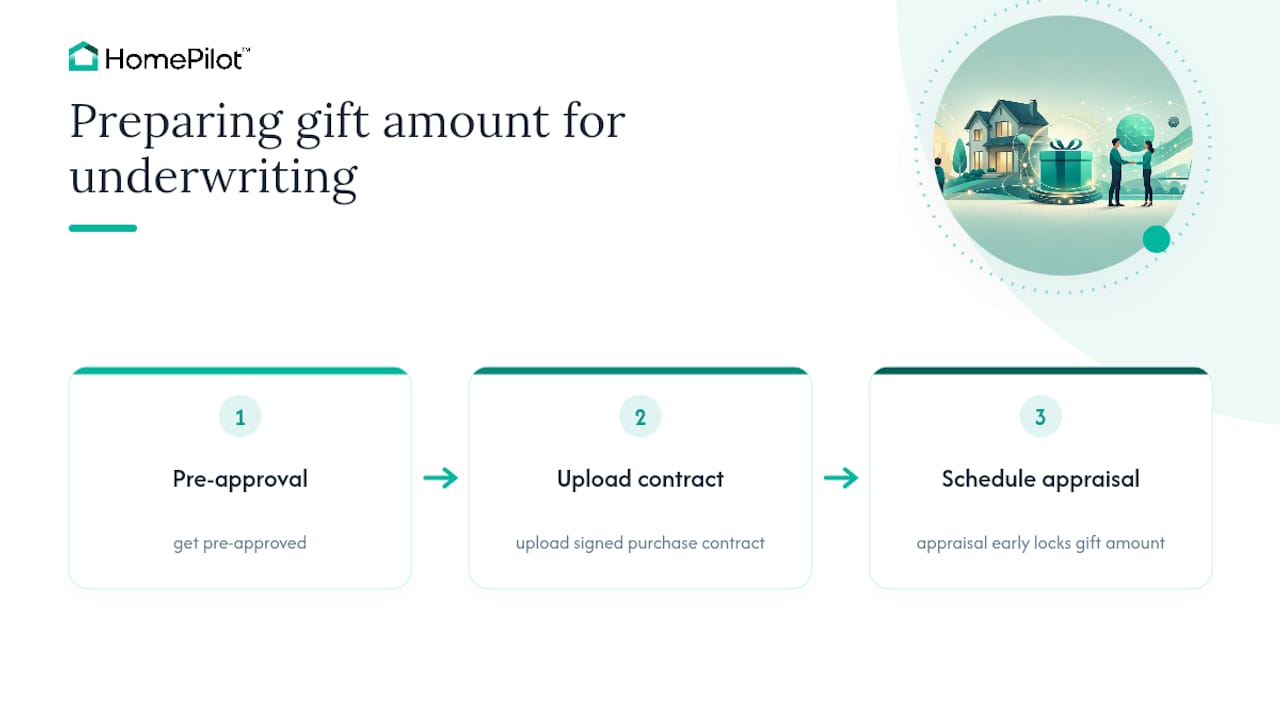
The practical next steps are the same ones any lender will ask for: get pre-approved, upload the purchase contract once it’s signed, and schedule the appraisal early so the gift amount is locked in before underwriting starts its review. Buyers who line those three things up before applying tend to close faster than families who figure it out mid-process.
What the Research Actually Tells Buyers and Sellers to Prioritize
Most articles on this topic bury the lead: the appraisal date, not the contract date, is what actually determines your gift amount, and families routinely negotiate a price before they know what the appraisal will say. That’s backwards. Get the appraisal first, then negotiate.
The other place conventional advice falls short is tax anxiety. Families hear “IRS reporting” and assume they’ll owe money. In reality, the $15,000,000 lifetime exemption means almost nobody writes a check to the IRS over a $60,000 or even $150,000 gift. Filing Form 709 is a paperwork exercise for the vast majority of donors, not a tax bill.
If you take one thing from this article, prioritize the documentation chain, appraisal, gift letter, settlement statement, matching perfectly, over everything else. That’s where real closings actually die.
Jack
Ready to Move Forward With a Gift of Equity Purchase?
A gift of equity still needs a lender who’s comfortable underwriting non-arm’s-length family sales, and not every loan officer processes these often enough to move quickly. HomePilot Mortgage gives you direct access to wholesale pricing from over 40 lenders, so instead of calling banks one at a time to find one that handles family transactions well, you get matched to lenders who already know how to structure the file.

Start by getting a free quote in about three minutes, no Social Security number or hard credit pull required, then upload your purchase contract and appraisal once they’re in hand. If you already have a Loan Estimate from another lender, HomePilot’s free loan estimate review compares it against live wholesale rates so you know whether you’re getting a fair deal before you sign. Families further along who want to explore tapping existing home equity instead of structuring a family sale can start there too. Either path begins the same way: get your numbers in front of the lenders who actually compete for your business.
Where This Information Comes From
The rules governing gifts of equity trace back to a handful of primary sources. Fannie Mae’s selling guide sets the conventional loan requirements, HUD’s buyer guidance covers FHA-specific documentation, and the IRS governs exclusion amounts and Form 709 reporting. Readers weighing the tax consequences of a related property sale can also review how inherited-property sales are taxed for additional context on basis and capital gains.
This article is general information, not a substitute for advice from a qualified financial advisor. Consult a qualified financial professional about your own circumstances before acting on anything here.
Sources
- IRS: IRS releases tax inflation adjustments for tax year 2026
- Fannie Mae selling guide, Gifts of equity (B3-4.3-05)
- HUD: Buying a home, loan information