2026 U.S. Jumbo Loan Requirements: FHFA Limits and Wholesale Rates
· By the HomePilot team · Reviewed by a licensed loan officer · Company NMLS #2752340

Loan limits move every year, so a number that made you jumbo in 2025 might not in 2026, depending on your county.
TL;DR:
- The 2026 conforming loan limit varies by county, with high-cost areas allowing loans up to 50% higher than the baseline limit.
- Lenders may set their own jumbo thresholds below or above FHFA limits, so borrowers should verify county-specific limits before applying.
- Qualification typically requires a credit score of at least 700, a debt-to-income ratio under 43%, and significant cash reserves of six to eighteen months of payments.
- Borrowers should prepare comprehensive documentation, including two years of tax returns and bank statements, and consider working with a broker to compare lender overlays and better rates.
- Jumbo loan processing usually involves manual underwriting, longer approval times, and higher appraisal and closing costs compared to conforming loans.
Table of Contents
- What Are Jumbo Loan Requirements and Why Do They Exist?
- Jumbo Loan Limits and How They’re Set
- Jumbo Loan Qualification Checklist: Credit, DTI, Down Payment, and Reserves
- How Lenders Underwrite Jumbo Loans and What Product You Choose
- How to Prepare and Apply for a Jumbo Loan
- The Broker Advantage Nobody Explains Well Enough
- Get a Real Jumbo Quote Without the Bank Runaround
- Where to Verify Your Own Numbers
- Sources
What Are Jumbo Loan Requirements and Why Do They Exist?
A jumbo loan is any mortgage that exceeds the conforming loan limit set by the Federal Housing Finance Agency, the ceiling Fannie Mae and Freddie Mac use to decide which loans they’ll buy from lenders. Once your loan crosses that line, Fannie and Freddie won’t touch it. The Consumer Financial Protection Bureau notes that this absence of a government-sponsored backstop is exactly why jumbo underwriting gets stricter. The lender is holding more risk on its own books, or selling to a private investor with its own appetite for risk, so it compensates by demanding a stronger borrower profile across the board.
That’s the whole logic of jumbo lending in one sentence: no Fannie or Freddie safety net means the lender tightens every other lever, credit, income, reserves, to make up for it.
Jumbo Loan Limits and How They’re Set
The FHFA recalculates conforming loan limits every year based on national home price changes, and it just announced the 2026 conforming loan limit values. Most U.S. counties share the same baseline limit for a single-unit home, but high-cost areas, think coastal California, parts of Colorado’s mountain corridor, and pockets of South Florida, get a higher ceiling because local home prices run well above the national median.
Here’s where people get tripped up: the conforming limit isn’t a flat national number once you factor in these adjustments.
- Baseline counties use the standard national limit for a one-unit property.
- High-cost counties get a higher ceiling, sometimes 50% above baseline, set county by county.
- Alaska, Hawaii, Guam, and the U.S. Virgin Islands automatically qualify for higher limits regardless of local price data.
- Multi-unit properties (two to four units) have their own higher limit tiers within the same county.
Two homes worth the same amount in different counties can land on opposite sides of the conforming line. A $950,000 purchase loan might be perfectly conforming in a high-cost California county and squarely jumbo in a lower-cost Texas market. That’s not a quirk, it’s the entire point of the county-by-county system.
On top of the FHFA number, individual lenders set their own internal jumbo cutoffs, which can be lower or structured differently than the federal limit. One lender might call anything over $1 million jumbo regardless of county; another sticks tight to the FHFA figure. Before you assume your loan amount is conforming or jumbo, check your specific county using the FHFA’s conforming loan limit map or the HUD high-cost area lookup tool. Both are free, and both update when limits change.
Jumbo Loan Qualification Checklist: Credit, DTI, Down Payment, and Reserves
Lenders evaluate jumbo applications on five fronts, and weakness in one rarely gets fully offset by strength in another. Here’s what each one actually requires.
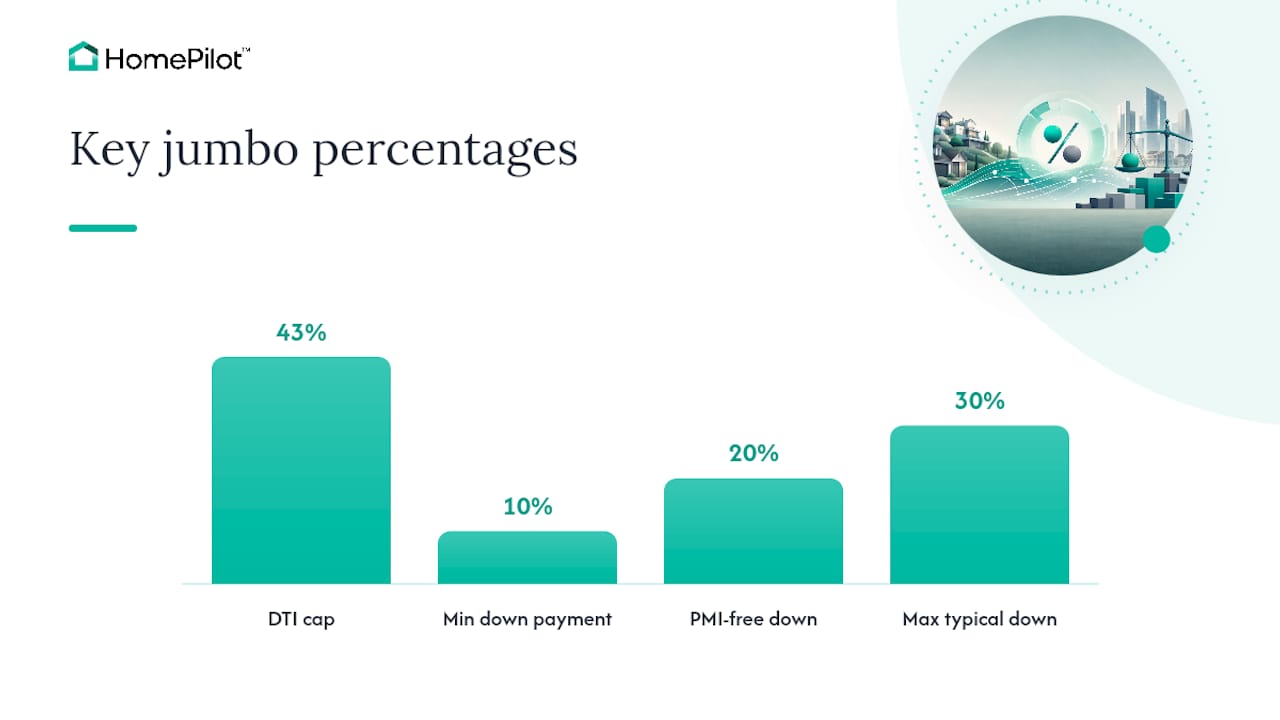
- Credit score. Most lenders want a minimum around 700, and a rate comparison site’s research confirms this is the common floor across the jumbo market. Scores in the 740 to 760 range typically unlock the best pricing tiers. Drop below 700 and you’re not automatically disqualified, but you’ll need stronger numbers everywhere else to compensate.
- Debt-to-income ratio. DTI is calculated by adding your total monthly debt payments (proposed mortgage, car loans, student loans, credit card minimums) and dividing by your gross monthly income. Jumbo lenders commonly cap this near 43%, according to CNBC Select’s coverage of lender practices, though some portfolio lenders flex higher for exceptionally strong files. Say you gross $25,000 a month. At a 43% ceiling, your total debt payments, mortgage included, can’t exceed $10,750.
- Down payment and loan-to-value ratio. Down payments on jumbo loans typically start at 10% and range up to 30% depending on loan size, credit profile, and property type. A 10% down payment usually triggers private mortgage insurance or a second-lien structure; put down 20% or more and you avoid PMI entirely while also improving your approval odds. The larger the loan relative to home value, the more scrutiny the file gets, so a lower LTV is one of the simplest ways to strengthen a borderline application.
- Cash reserves. Reserve requirements for jumbo loans commonly run from six months up to eighteen months of full mortgage payments, sitting untouched in liquid or near-liquid accounts after closing. A borrower with a $6,000 monthly payment facing a 12-month reserve requirement needs $72,000 sitting in checking, savings, or eligible investment accounts beyond the funds used for closing. Retirement accounts sometimes count at a reduced percentage, but that varies by lender.
- Income documentation. W-2 employees generally need two years of W-2s, recent pay stubs, and two years of tax returns. Self-employed borrowers face a heavier lift: two years of full tax returns, profit-and-loss statements, sometimes K-1s if you hold interest in a partnership or S-corp, and occasionally a CPA letter confirming your business’s financial standing. Gift funds are usually allowed for part of the down payment, but expect a signed gift letter and a paper trail showing the money moved from the giver’s account to yours.
Pro Tip: If your DTI or credit score sits right on the edge, don’t wait for a lender to flag it. Tell us up front, build your reserve cushion first, and we price the file with that in mind.
Lenders also weigh compensating factors when a file isn’t perfect on paper. Large liquid asset pools, a low LTV, or a documented history of consistent large deposits can offset a slightly elevated DTI or a credit score just under the usual floor. This is part of why shopping multiple lenders or working with a broker matters so much for jumbo borrowers specifically: since Fannie and Freddie aren’t setting a uniform standard, each lender’s overlays and reserve math can differ meaningfully for the same borrower profile.
How Lenders Underwrite Jumbo Loans and What Product You Choose
Jumbo underwriting leans more heavily on manual review than conforming loans do. Automated underwriting systems built around Fannie and Freddie’s rules don’t apply the same way, so a human underwriter is often tracing your income, assets, and liabilities by hand rather than trusting an algorithm.
Manual underwriting shows up most often for:
- Self-employed borrowers with income that swings year to year
- Real estate investors with multiple properties and cash-flow-based income rather than a salary
- Borrowers with large but recently acquired asset pools, like an inheritance or a business sale
- Files where automated systems flag inconsistencies that need a human explanation
For real estate investors specifically, lenders will often look past W-2 income entirely and evaluate rental cash flow, existing mortgage obligations across a portfolio, and liquidity. A borrower with a $200,000 salary and a borrower with $80,000 in salary plus $150,000 in net rental income can both qualify, but they’ll go through very different documentation paths to get there.
Your product choice matters more than most borrowers expect. A 30 year fixed jumbo loan offers payment stability and is the most common choice for primary residences. A 15 year fixed pays off faster and usually carries a lower rate, but the higher monthly payment can push your DTI past the ceiling on a large loan amount. Adjustable-rate jumbo loans often start with a lower initial rate, which can help a borderline DTI qualify in the early years, but they carry rate-adjustment risk down the line that fixed-rate borrowers don’t face.
Pricing on jumbo loans doesn’t move in lockstep with conforming rates. Sometimes jumbo rates run higher because of the added risk lenders absorb without Fannie or Freddie backing the loan; other times, in certain rate environments, jumbo pricing actually undercuts conforming pricing because lenders are competing hard for high-balance, high-quality borrowers. A strong credit score, low LTV, and ample reserves are the three factors most likely to narrow that spread in your favor.
How to Prepare and Apply for a Jumbo Loan
Getting from “I think I need a jumbo loan” to a closed transaction runs smoother when you front-load the paperwork instead of scrambling once you’re under contract.
- Gather your documents early. You’ll need two years of tax returns, W-2s or 1099s, recent pay stubs, two to three months of bank statements across all accounts, retirement account statements, and, if self-employed, K-1s and profit-and-loss statements covering the current year.
- Get preapproved before you shop. On high-value properties, sellers and their agents expect a real preapproval letter, not a prequalification guess. A preapproval also surfaces any documentation gaps before you’re racing a contract deadline.
- Expect a longer underwriting window. Jumbo loans commonly take longer to underwrite and close than conforming loans because manual review takes more time and appraisals on higher-value homes can be harder to schedule and complete. Title issues on unique or high-value properties can add delays too.
- Budget for the cost structure. Appraisal fees on jumbo properties run higher than on conforming homes because the appraisal itself requires more work. Origination fees can also run higher on jumbo loans, though this varies significantly by lender, which is exactly why comparing offers from multiple lenders matters. Mortgage interest on jumbo loans may still be deductible up to certain limits, and IRS Publication 936 lays out the specific rules if that factors into your decision.
- Improve your file before you apply, not during underwriting. Pay down revolving debt to improve DTI, avoid opening new credit lines in the months before applying, and let large deposits season in your account for at least two months so they don’t require extra documentation.
Jumbo reserve requirements alone can run as high as eighteen months of mortgage payments for some lenders and loan sizes, which is a major reason many borrowers underestimate how much liquid cash they need on hand before they ever get to the closing table. Also, when the closing date gets set, confirm wire instructions directly with your title company by phone, never by email alone. Real estate transactions are a common target for wire fraud, and jumbo closings, with their larger dollar amounts, are an especially attractive target for scammers spoofing title company emails.
The Broker Advantage Nobody Explains Well Enough
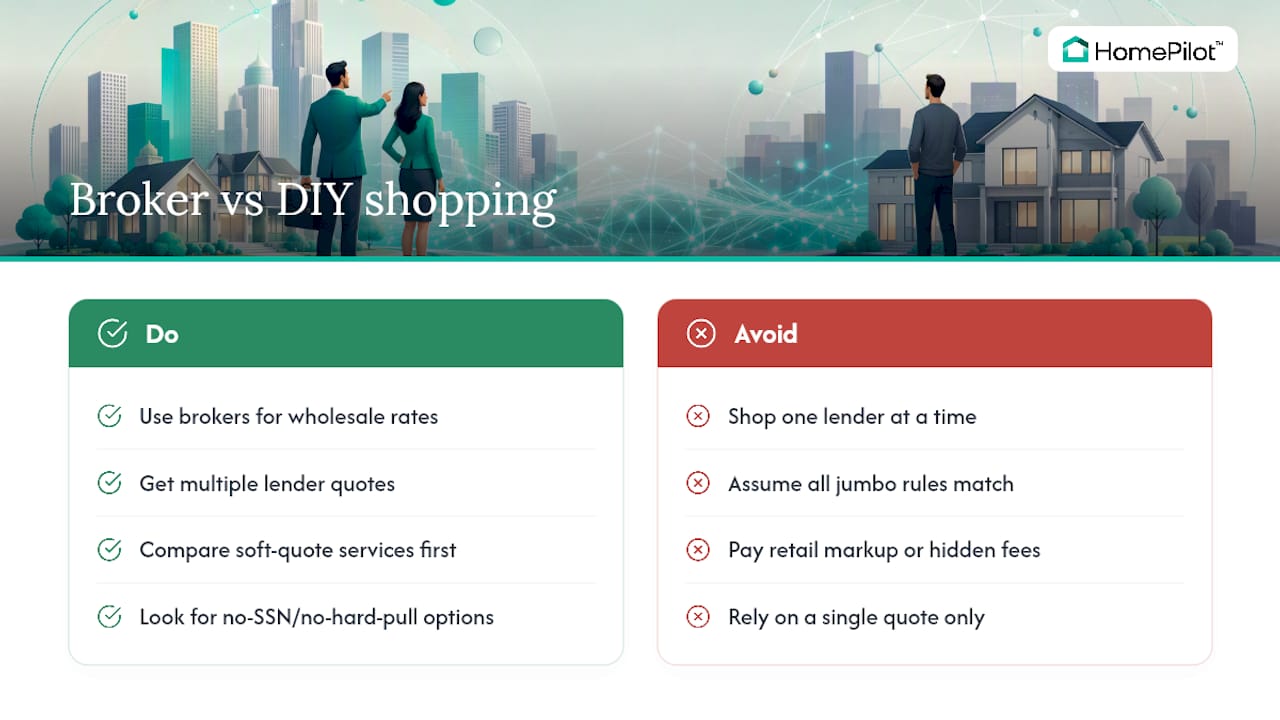
Most articles on jumbo qualification stop at the checklist and leave you to go find a lender on your own. That’s where the real friction lives, and it’s exactly the part HomePilot handles for you. Jumbo loans aren’t standardized the way conforming loans are, so the same borrower can get approved by one lender and declined by another purely because of differing overlays on reserves, DTI, or asset seasoning. Shopping one lender at a time is slow and it hides how much variation actually exists in the market.
HomePilot Mortgage gives borrowers direct access to wholesale jumbo pricing across 40+ lenders, with no processing or underwriting fees and none of the retail markup that pads a lot of jumbo quotes. You can see your numbers in minutes with no hard credit pull to start, and because we price the same file across many lenders at once, differences in overlays and reserve requirements show up before you apply, not after a rejection. Our rates are published beside the national average every business day.
Jack
Get a Real Jumbo Quote Without the Bank Runaround
Some mortgage brokers specialize in jumbo loans, a field where reserve requirements, DTI ceilings, and pricing can vary significantly among lenders. Rather than contacting banks individually, some brokers match borrowers with multiple lenders simultaneously, often providing wholesale pricing options.
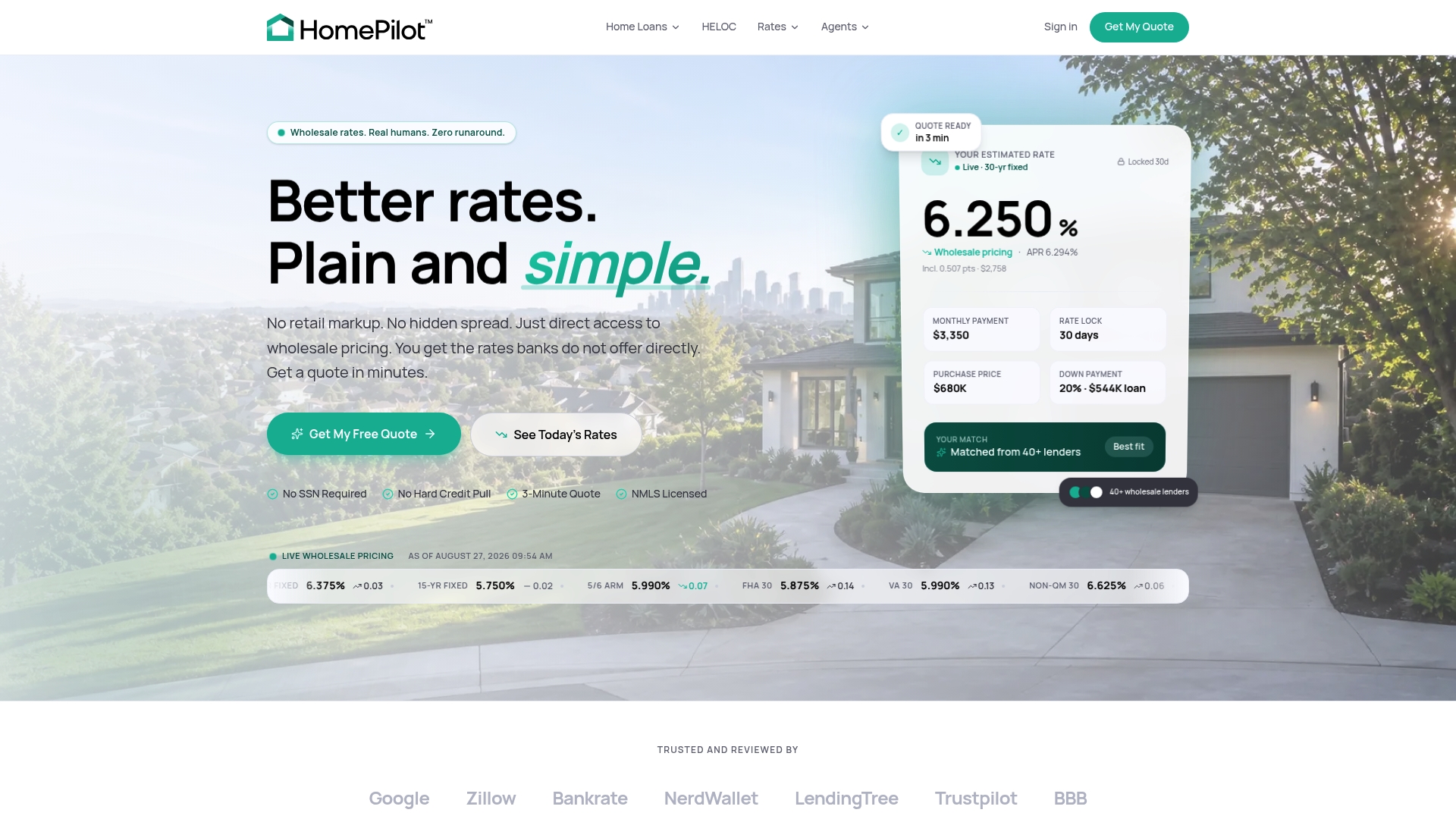
If you’re still gathering documents, start with the mortgage broker page to see how the matching process works for jumbo borrowers specifically. Already have a loan estimate from another lender? Run it through the free loan estimate review to see whether wholesale pricing beats what you were quoted. Some platforms provide quick quotes without a hard credit pull, allowing comparison of mortgage numbers without impacting credit scores.
Where to Verify Your Own Numbers
Check your county’s exact conforming limit using the FHFA’s loan limit map, and confirm high-cost adjustments through HUD’s lookup tool. Read the CFPB’s plain-language jumbo loan explainer for the regulatory basics, and verify any lender or broker’s license through NMLS Consumer Access before signing anything.
This article is general information, not a substitute for advice from a qualified financial advisor. Consult a qualified financial professional about your own circumstances before acting on anything here.