0% to 3% Down in the U.S.: Broker Quotes for Low Down Mortgages
· By the HomePilot team · Reviewed by a licensed loan officer · Company NMLS #2752340

Several loan types let qualified buyers close with 0% to 3% down: VA and USDA loans for eligible veterans and rural borrowers, FHA loans at 3.5% down, and conventional programs like HomeReady, Home Possible, and HomeOne at 3% down. Each comes with its own fees, mortgage insurance rules, and eligibility limits. The smartest move is comparing your actual eligibility across programs, then requesting quotes from more than one source before you pick one.
TL;DR:
- Most low down payment programs require mortgage insurance or fees that significantly increase monthly costs, especially at higher loan-to-value ratios.
- Eligibility varies by credit score and income limits, with FHA allowing as low as 580 credit scores and many conventional programs requiring at least 620.
- Gift funds, down payment assistance, community seconds, and employer programs can help cover the down payment, but they may affect overall loan limits or eligibility.
- Comparing quotes from multiple lenders or brokers can reveal better program options and actual costs, as price negotiations mainly happen behind the scenes in wholesale lending.
- Ensuring your financial documents are ready and understanding the specific costs and conditions of each program can save time and money during the homebuying process.
Table of Contents
- Which Low Down Payment Mortgage Programs Actually Exist
- What It Actually Costs: Eligibility, LTV, and Mortgage Insurance
- Where the Down Payment Money Can Come From
- Broker Vs. Lender: Who Actually Finds You the Right Program
- How to Choose the Right Program and Apply
- What Our Team Sees Most Often With Low-Down Borrowers
- Get Your Numbers Before You Commit to a Program
- Sources
- FAQ
Which Low Down Payment Mortgage Programs Actually Exist
The phrase “low down payment mortgage” covers a handful of distinct federal and government sponsored enterprise (GSE) programs, each with its own rulebook. Here’s what separates them.
FHA loans require as little as 3.5% down for borrowers with a credit score of 580 or higher, though some lenders go as low as 500 with 10% down. FHA loans carry both an upfront mortgage insurance premium and an ongoing annual premium, and unlike conventional mortgage insurance, FHA’s annual premium often lasts the life of the loan unless you refinance out of it. The HUD handbook 4000.1 governs underwriting standards for these loans and is the primary source for FHA property and borrower eligibility rules.
VA loans allow 0% down for eligible veterans, active-duty service members, and certain surviving spouses. There’s no monthly mortgage insurance, but most borrowers pay a one-time VA funding fee, which varies by down payment size and whether it’s a first or subsequent use of the benefit. Veterans with a 10%+ disability rating are typically exempt from that fee.
USDA charges an upfront guarantee fee plus a smaller annual fee, both of which factor into your real monthly cost even though there’s no down payment.
Conventional 97% LTV programs cover the rest of the field:
- Fannie Mae HomeReady: 3% down, accepts nontraditional income sources, and applies area median income limits for eligibility.
- Freddie Mac Home Possible: 3% down with similar income caps, designed for lower and moderate income buyers.
- Freddie Mac HomeOne: 3% down with no income limit, generally aimed at first-time homebuyers.
Most of these programs work for single-family homes, condos, and some multi-unit owner-occupied properties, though rules on investment and second homes differ sharply by program.
What It Actually Costs: Eligibility, LTV, and Mortgage Insurance
A low down payment doesn’t mean low cost. It usually means the cost shows up somewhere else, most often in mortgage insurance or program fees.
Loan-to-value (LTV) is the loan amount divided by the home’s value. Combined loan-to-value (CLTV) and total loan-to-value (TLTV) add in any second liens or subordinate financing, like a down payment assistance loan. The higher your LTV, the more mortgage insurance typically costs and the tighter underwriting tends to get.
Here’s the general shape of eligibility across programs:
- Credit score: FHA can go as low as 580 for 3.5% down; conventional 97% programs usually want 620 or higher; VA and USDA have no hard federal minimum, but individual lenders set their own floors.
- Debt-to-income (DTI): Most programs target a DTI in the 43% to 50% range, though compensating factors like reserves or strong credit can stretch that.
- Income limits: HomeReady and Home Possible cap eligibility at 80% of area median income in most cases; HomeOne, FHA, VA, and USDA (for the guaranteed program) generally don’t impose that same income ceiling.
Pro Tip: Ask for your Loan Estimate before you commit to a program. Comparing the mortgage insurance line item side by side often reveals more about true monthly cost than the interest rate does.
VA has no monthly mortgage insurance at all, just the funding fee.
Where the Down Payment Money Can Come From
You don’t have to save every dollar yourself. Several funding sources are standard practice across nearly every low down payment program.
- Gift funds. Family members, and in some cases close friends or employers, can gift money toward your down payment. Lenders require a signed gift letter confirming the funds don’t need to be repaid, plus a documented paper trail showing the money moved from the giver’s account to yours.
- Down payment assistance (DPA) programs. State housing finance agencies and local governments run grant and low-interest second mortgage programs, often stacked on top of an FHA or conventional first mortgage.
- Community Seconds®. Fannie Mae permits certain subordinate financing arrangements, called Community Seconds, to work alongside HomeReady and other conventional loans, which can cover part or all of the down payment.
- Employer assistance programs. Some employers offer down payment grants or forgivable loans as a hiring or retention benefit.
The National Council of State Housing Agencies maintains a directory of state and local housing help resources, a useful starting point for finding programs specific to where you’re buying.
Pro Tip: Line up any gift letters or DPA approval before you’re deep into a purchase contract. Assistance funds that arrive late can delay closing by weeks.
Down payment assistance can raise your combined loan-to-value, which some programs cap. Confirm how a second lien affects your overall eligibility before you count on it.
Broker Vs. Lender: Who Actually Finds You the Right Program
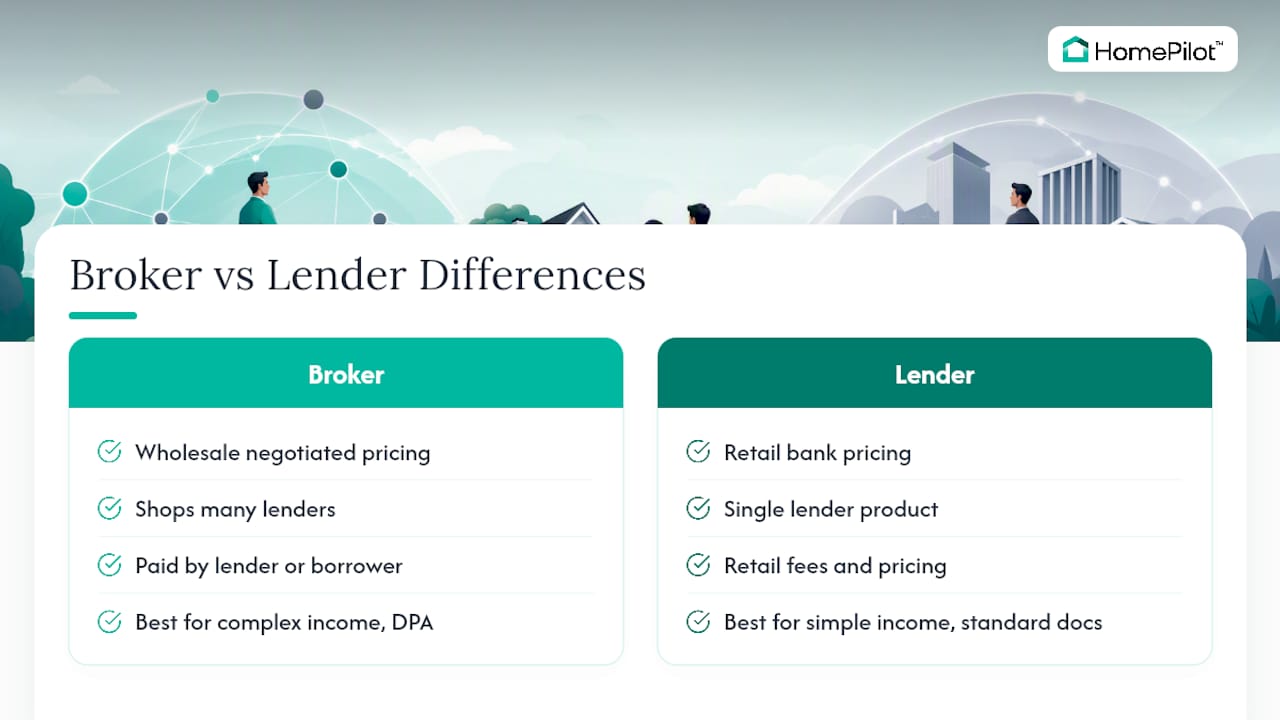
A lender makes the loan directly. A broker shops your file across multiple lenders and can be compensated by either the lender or the borrower, according to the Consumer Financial Protection Bureau. That distinction matters more than most buyers realize when you’re trying to match a specific program, like HomeReady versus Home Possible versus FHA, to your exact income and credit situation.
Wholesale lending, the channel brokers plug into, differs from retail lending in one key structural way: retail lenders sell you their own priced product, while a broker prices your file off lenders’ wholesale rate sheets and adds its own margin on top.
A broker who works across dozens of wholesale lenders can screen your file against several low-down programs at once, which matters when your income is irregular or you’re trying to combine a GSE loan with down payment assistance.
HomePilot Mortgage prices files across 40+ wholesale lenders and keeps only a thin margin on the winning price, with $0 lender fees. We publish our live rates alongside the national average every business day so you can check the numbers yourself, and we back that pricing with a published $500 Best Price Guarantee on eligible offers (terms apply).
Complex income, nonstandard documentation, or wanting one place to compare program fits: those are the exact situations where working with a broker instead of a single bank tends to save the most money and time.
How to Choose the Right Program and Apply
Picking a program comes down to four questions: which one you actually qualify for, what it costs monthly once mortgage insurance or fees are included, how long you plan to keep the loan, and whether you can cover closing costs on top of the down payment.
Before you apply, gather proof of income (pay stubs, tax returns, or bank statements for self-employed income), asset statements, government ID, and any gift letters tied to your down payment.
- Check your eligibility against FHA, VA, USDA, and conventional 97% guidelines for your credit score and income.
- Compare total monthly cost, not just the rate, using a mortgage calculator to model mortgage insurance and fees.
- Move forward with the lender or broker offering the strongest combination of cost and fit.
Pro Tip: If your credit score is borderline or you have no cash reserve for closing costs, pausing six months to save and improve credit sometimes beats rushing into a 3.5% down loan with a higher rate.
What Our Team Sees Most Often With Low-Down Borrowers
Most low-down buyers we work with aren’t confused about wanting a home. They’re confused about which program actually fits their income and credit profile, and that confusion costs them money when they settle for the first offer they see.
Pricing across 40+ wholesale lenders lets us show a borrower several program options side by side instead of one bank’s single answer. Our $500 Best Price Guarantee (eligible offers, terms apply) exists because we believe borrowers deserve to see the math, not just take our word for it.
The HomePilot Team
Get Your Numbers Before You Commit to a Program
HomePilot Mortgage gives you something a single bank can’t: real pricing from 40+ wholesale lenders on the same file, so you’re not stuck with one institution’s take on what you qualify for.

Start by checking today’s live rates against the national average, updated every business day. If you want to see how a low down payment program actually pencils out for your budget, run the numbers with our mortgage calculator or get a purchase quote in minutes with no hard credit pull required. Already have a Loan Estimate from somewhere else? Send it through our free Loan Estimate review and we’ll tell you straight whether it’s competitive. Our $500 Best Price Guarantee applies to eligible offers, terms apply, and most purchases close in about 20 days from accepted offer, with a standard commitment of 30 days or less.
Sources
This guide draws on HUD’s underwriting handbook, VA funding fee guidance, USDA upfront fee notes, Fannie Mae’s HomeReady program page, Freddie Mac’s Home Possible page, and CFPB consumer guidance. Confirm current eligibility rules directly on each program’s official page, and verify any broker or lender’s license through NMLS Consumer Access.
This article is general information, not a substitute for advice from a qualified financial advisor. Consult a qualified financial professional about your own circumstances before acting on anything here.
- What is the difference between a mortgage lender and a mortgage broker? - CFPB
- VA funding fee and closing costs - U.S. Department of Veterans Affairs
- USDA Single Family Housing upfront fee notes - USDA RD
FAQ
What type of mortgage has the lowest down payment?
VA and USDA loans allow 0% down for eligible veterans and qualifying rural borrowers, the lowest of any major program.
How much do you need for a down payment on a $300,000 house?
It depends on the program: 3% down on a conventional loan is $9,000, FHA’s 3.5% minimum is $10,500, and 20% down, the level that avoids private mortgage insurance on a conventional loan, is $60,000. VA and USDA eligible borrowers could put $0 down, though closing costs and program fees still apply regardless of down payment size.
Can I buy a house with a $30,000 down payment?
On a typical home, a down payment around 7% to 8% can open up more conventional loan options with lower mortgage insurance costs.
How much house can I afford with a $10,000 down payment?
On the down payment alone, $10,000 covers 3.5% down on an FHA purchase up to about $285,000, or 3% down on a conventional purchase up to about $333,000, before closing costs. Your actual affordability also depends on income, credit score, and debt-to-income ratio, so comparing multiple quotes gives a clearer picture than the down payment math alone.
Recommended
- Temporary Buydown Calculator (3/2/1, 2/1, 1/1, 1/0)
- Mortgage Calculators
- California Mortgage Broker, Wholesale Rates from HomePilot
- Texas Mortgage Broker, Wholesale Rates from HomePilot
HomePilot Mortgage, NMLS #2752340, is a licensed mortgage broker in Arizona, California, Colorado, Florida, and Texas. Equal Housing Lender. This article is general information, not a loan offer or a commitment to lend. Rates and program terms change daily and depend on credit, loan amount, and county. HomePilot Mortgage is a private company, not affiliated with or endorsed by the Department of Veterans Affairs, HUD, or any government agency.