Buy Again After Foreclosure in the U.S.: 2–7 Year Timeline, Loans, Docs
· By the HomePilot team · Reviewed by a licensed loan officer · Company NMLS #2752340

Buy Again After Foreclosure in the U.S.: 2 to 7 Year Timeline, Loans, Docs

You can get a mortgage after foreclosure. The wait ranges from a few years for VA loans to several years for conventional financing, and the gap between those numbers usually comes down to three things: documented hardship, rebuilt payment history, and cash reserves. Get those right, and the calendar often works in your favor faster than you’d think.
TL;DR:
- Veterans and service members with remaining entitlement may qualify for a VA loan roughly two years after foreclosure, assuming stable income and credit rebuilding.
- USDA and FHA loans usually require a three-year wait, which can be shortened with documented extenuating circumstances such as job loss or medical crisis.
- Conventional loans typically need a seven-year wait, reducible to three years with proof of unavoidable hardship, and non-QM loans may be available sooner but with higher costs.
- Building a strong recovery file involves demonstrating timely payments, sufficient cash reserves, and a credible hardship explanation supported by documentation.
- Underwriters look for recent payment history, actual cash reserves, and stable income, often valuing reserves more than credit score alone, even several years after foreclosure.
Table of Contents
- How Long After Foreclosure Can You Buy a House?
- What Counts as an Extenuating Circumstance?
- What Do Underwriters Look For After a Foreclosure?
- The Staged Recovery Plan: What to Do and When
- Which Loan Program Fits Your Timeline?
- Why Timing Alone Doesn’t Get You Approved
- Ready to Check Your Options After Foreclosure?
- Where to Verify Waiting Periods and Get Help
- Sources
- FAQ
How Long After Foreclosure Can You Buy a House?
Every major loan program measures its waiting period from the same starting point: the recorded foreclosure sale or title transfer date, not the day you stopped making payments or moved out. Get that date wrong on an application and the file can get denied automatically, according to Bankrate’s guide on qualifying after foreclosure.
Waiting periods vary by loan type, with VA loans generally having the shortest standard wait, typically available only to eligible veterans, service members, and some surviving spouses with remaining entitlement.
- FHA loans: a standard three-year rule under HUD’s loss mitigation framework, which also lays out options that can prevent foreclosure entirely.
- USDA loans generally have a waiting period along with specific rural-area and household income eligibility requirements.
- Conventional loans: a seven-year standard under the Fannie Mae servicing guide, reducible to three years with documented extenuating circumstances.
- Non-QM loans do not have a fixed federal waiting period but often involve higher rates, larger down payments, and lender-specific criteria.
The pattern holds across programs: government-backed loans move faster than conventional ones, and documentation is what closes the gap.
What Counts as an Extenuating Circumstance?
Extenuating circumstances mean a sudden, unavoidable event beyond your control caused the foreclosure, not financial mismanagement. A job loss from a plant closure, a medical crisis with mounting bills, a divorce that cut household income in half. These typically qualify. Ongoing credit card debt or a habit of missing payments before the hardship hit generally does not.
Documentation standards differ by program. HUD, Fannie Mae, and the VA each evaluate hardship claims independently, so a waiver granted under one program’s rules doesn’t automatically carry over to another. Before you build a case, confirm the exact foreclosure sale or title transfer date on the county recorder’s record. That date, not your memory of when things fell apart, is what the underwriter measures against.
To build a credible extenuating-circumstances file:
- Pull the recorded sale date from the county or your prior servicer.
- Gather proof tying the hardship directly to the missed payments (medical bills, termination notice, divorce decree).
- Collect pay stubs, tax returns, or benefit letters showing your income has since stabilized.
- Write a timeline that connects the hardship’s start and end dates to when payments actually stopped.
Pro Tip: Lenders reward a timeline, not a sob story. Show the exact month income dropped, the exact month it recovered, and match that against your credit report’s payment history line by line.
The most common pitfall: submitting a hardship letter with no supporting paperwork, or a timeline that doesn’t line up with what the credit bureau shows. Underwriters cross-check both.
What Do Underwriters Look For After a Foreclosure?
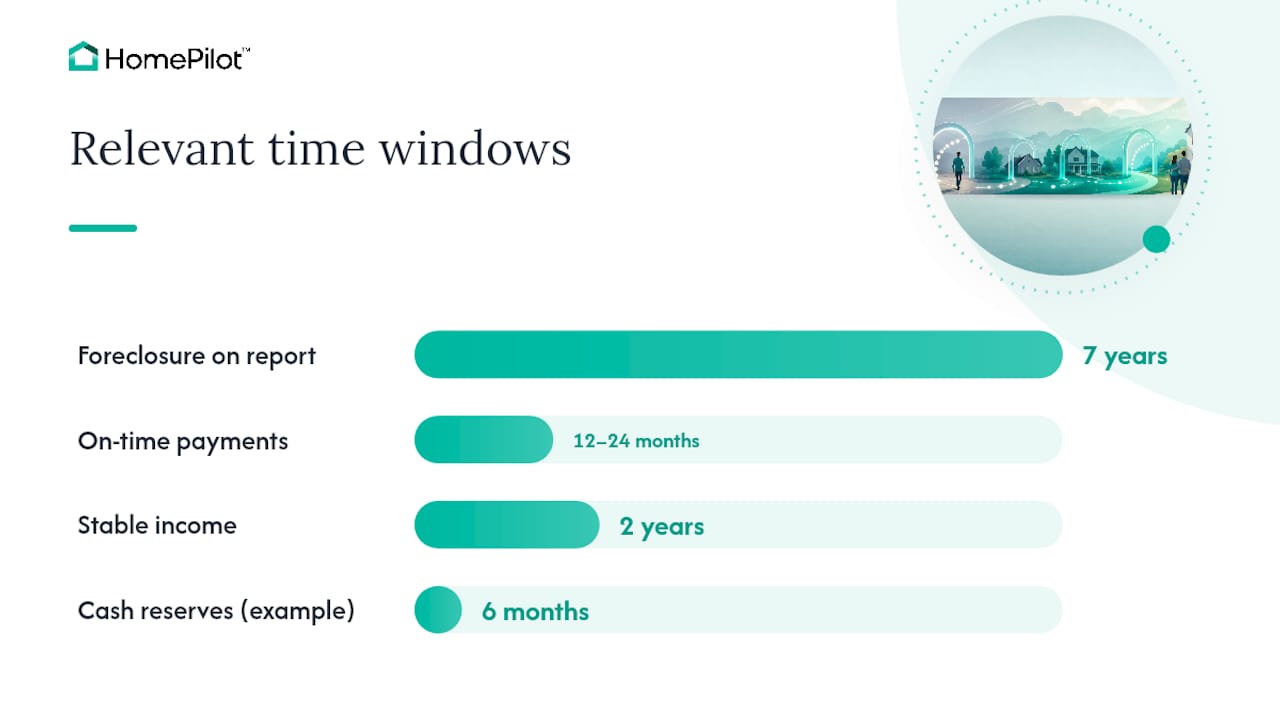
Foreclosure information stays on your credit report for seven years, but that number alone doesn’t decide your fate. What matters more to most underwriters is what you’ve done since.
Underwriters typically weigh:
- Twelve to twenty-four months of clean, on-time payments across every open account.
- Cash reserves, often several months of housing payments, sitting untouched in a bank account.
- Debt-to-income ratio and at least two years of stable, verifiable income.
- A credit report free of new collections, late payments, or charge-offs since the foreclosure.
Reserves often carry more weight than people expect after a foreclosure. Lenders view cash on hand as proof you can absorb a shock without missing another payment, and that signal can matter as much as the credit score itself. A borrower with a 640 score and six months of reserves frequently outperforms a borrower with a 680 score and none.
Build your file to show recovery in every column at once: payment history, income, savings, and debt load moving in the right direction together.
The Staged Recovery Plan: What to Do and When
Treat the path back to homeownership as a project with phases, not a single application you’ll file someday.
Right now:
- Pull your credit reports from all three bureaus and confirm the recorded foreclosure sale date.
- Dispute any inaccuracies, especially wrong dates or accounts that should have been discharged.
- Save every document related to the hardship: termination letters, medical bills, divorce filings, correspondence with your old servicer.
The next 12 months: 4. Open or maintain a couple of tradelines and pay every bill on time, every month, without exception. 5. Stabilize income. A job change right before applying raises red flags even when the new job pays more. 6. Avoid new debt, including “buy now, pay later” balances that show up as installment loans.
From 12 months to your program’s wait date: 7. Grow reserves toward several months of housing payments. 8. Assemble hardship evidence into one organized folder: timeline, letters, pay stubs, tax returns. 9. If your timeline is tight, ask about non-QM or portfolio options that don’t follow the standard federal wait.
Pro Tip: Build your document folder like you’re handing it to a stranger who’s never met you. Label everything by date, and lead with the timeline page. That’s usually the first thing an underwriter actually reads.
Which Loan Program Fits Your Timeline?
Match the program to where you actually stand, not where you wish you stood.
- Eligible veterans and service members with remaining entitlement usually clear VA’s roughly two-year wait fastest, assuming re-established credit and stable income.
- Borrowers with lower credit scores but a clean two to three years since foreclosure often fit FHA’s three-year standard best, especially with a documented hardship file.
- Rural buyers under USDA income limits face the same three-year rule as FHA, plus property location requirements that rule out most suburban and urban addresses.
- Borrowers past the seven-year mark, or those with a strong extenuating-circumstances case cutting it to three years, typically move toward conventional financing with standard loan-to-value limits.
- Borrowers who can’t wait, and who can absorb a higher rate, sometimes find non-QM or portfolio loans available sooner, though Forbes Advisor notes these carry higher costs and vary widely by lender.
None of these paths are mutually exclusive over time. Plenty of borrowers start with a non-QM loan at year two, then refinance into a conventional loan once they hit year seven.
Why Timing Alone Doesn’t Get You Approved
Most articles on this topic treat the waiting period like a countdown clock: wait long enough, and the door opens. That’s only half true. We’ve found the borrowers who get approved fastest aren’t the ones who waited the longest. They’re the ones who treated the wait as a construction project, building credit, income proof, and reserves in parallel rather than letting time pass and hoping the math works out. A shorter wait with a airtight documentation file often beats a longer wait with a thin one. Working across 40 or more wholesale lenders means we see which underwriters actually flex on extenuating circumstances and which don’t, and that knowledge is worth more to a recovery borrower than another year of waiting.
, The HomePilot Team
Ready to Check Your Options After Foreclosure?
HomePilot Mortgage is the alternative to walking into a single bank branch and hoping their one rate sheet fits your recovery story. As a family-owned wholesale broker licensed in Arizona, California, Colorado, Florida, and Texas, we price every file across 40+ wholesale lenders instead of pitching you one institution’s guidelines, and we pass the winning pricing through with $0 lender fees.

We publish live wholesale rates next to the national average every business day, so you can see where recovery-stage pricing actually stands before you apply anywhere. We also back our pricing with a published $500 Best Price Guarantee on eligible offers, terms apply. If your documentation is ready, purchases typically move from accepted offer to closing in about 20 days. Start with a no-hard-pull quote and tell us about your foreclosure timeline. We’ll help you figure out whether FHA, VA, or a specialty program fits your situation, and if you already have an offer from somewhere else, our free loan estimate review will tell you if it’s actually competitive.
Where to Verify Waiting Periods and Get Help
- CFPB: buying a home after foreclosure
- HUD FHA loss mitigation options
- Fannie Mae servicing guide on workout options
- Florida foreclosure assistance programs and hotlines
This article is general information, not a substitute for advice from a qualified financial advisor. Consult a qualified financial professional about your own circumstances before acting on anything here.
Sources
- If I lose my home to foreclosure, can I ever buy a home again? What impact will a foreclosure have on my credit report? | CFPB
- FHA loss mitigation options | HUD
- Fannie Mae’s home retention and liquidation workout options
- How to get a mortgage after foreclosure | Bankrate
FAQ
How Hard Is It to Get a Mortgage After a Foreclosure?
It’s harder in the first two to three years but becomes routine once you clear your program’s waiting period with re-established credit, stable income, and reserves in place.
Can a Mortgage Company Come After You After Foreclosure?
Depending on your state and loan terms, a lender may pursue a deficiency judgment for the difference between what you owed and what the home sold for; the CFPB’s guidance on foreclosure and credit impact covers how this varies.
Am I Forgiven on a Bank Loan if It Goes to Foreclosure?
Foreclosure resolves the lender’s claim to the property, but it doesn’t automatically forgive any remaining loan balance. Whether you owe more depends on your state’s laws and whether the sale covered the full debt.
Can I Get a Mortgage 2 Years After Foreclosure?
Yes, if you qualify for a VA loan, where the typical wait is about two years. FHA, USDA, and conventional loans generally require three years or longer unless documented extenuating circumstances apply.
What Loan Options Exist If I Can’t Wait the Full Period?
Non-QM or portfolio loans sometimes offer paths sooner than federal minimums, though they usually carry higher rates. Working with a broker like HomePilot Mortgage that prices across multiple wholesale lenders can help you find which programs are realistically available for your timeline.
Recommended
HomePilot Mortgage, NMLS #2752340, is a licensed mortgage broker in Arizona, California, Colorado, Florida, and Texas. Equal Housing Lender. This article is general information, not a loan offer or a commitment to lend. Rates and program terms change daily and depend on credit, loan amount, and county. HomePilot Mortgage is a private company, not affiliated with or endorsed by the Department of Veterans Affairs, HUD, or any government agency.