Most U.S. Mortgages Have No Prepayment Penalty: Run a Break-Even First
· By the HomePilot team · Reviewed by a licensed loan officer · Company NMLS #2752340

Most mortgages closed in the U.S. today do not carry a prepayment penalty, and federal rules keep the ones that do exist narrow and short-lived. FHA, VA, USDA, and federal credit-union loans prohibit them outright. If your loan has one, it has to show up in writing. Check your Loan Estimate, Closing Disclosure, and the promissory note’s addenda before you sign anything.
TL;DR:
- Federal rules restrict prepayment penalties to only a small percentage of the loan balance in the first three years, with the cap dropping from 2% to zero afterward.
- Most mortgages, including FHA, VA, USDA, and federal credit unions, prohibit prepayment penalties altogether, and loans with penalties must clearly disclose the terms.
- The actual cost of a prepayment penalty varies depending on the calculation method and could amount to months’ worth of interest, influencing the decision to refinance or pay early.
- Running break-even analyses is crucial to determine if refinancing or paying off early makes financial sense given the penalty, loan costs, and intended holding period.
- State laws can further restrict or prohibit prepayment penalties beyond federal limits; borrowers should verify their local regulations before assuming they owe a fee.
Table of Contents
- What Is a Prepayment Penalty Mortgage and When Does It Trigger?
- Hard vs. Soft Penalties and How the Fee Gets Calculated
- How Much Could a Prepayment Penalty Actually Cost You?
- Federal Rules That Cap and Limit Prepayment Penalties
- Does Your State Ban or Limit Mortgage Prepayment Fees?
- Selling, Refinancing, or Paying Down Early: Which Move Makes Sense?
- How HomePilot Mortgage Helps You Evaluate a Penalty-Bearing Loan
- A Practical Take on Paying the Penalty vs. Waiting It Out
- Compare Your Loan Before You Assume You’re Stuck With a Penalty
- Sources
What Is a Prepayment Penalty Mortgage and When Does It Trigger?
A prepayment penalty is a fee a lender charges when you pay off all or a large chunk of your mortgage earlier than the loan’s schedule anticipated. The CFPB defines it plainly: it’s compensation for interest the lender expected to collect over the life of the loan and won’t now receive. Lenders who sell fixed-rate loans on the secondary market, in particular, price in years of predictable interest income, and an early payoff disrupts that math.
The fee almost never triggers on your regular monthly payment. It typically applies when you sell the home and pay off the loan in full at closing, refinance into a new mortgage that pays off the old one in a lump sum, or make a large, one-time principal payment that exceeds any penalty-free limits specified in your note.
Routine extra payments, like tacking an extra $200 onto your monthly principal, typically fall under what’s called a “prepayment privilege” and don’t trigger anything. The exact rules live in your paperwork. Look at the Loan Estimate and Closing Disclosure you received during the mortgage application, then check the promissory note itself and any attached prepayment addendum or rider. That’s where the CFPB says the actual triggering language lives, and it’s worth five minutes with your closing folder to confirm before you assume anything.
Hard vs. Soft Penalties and How the Fee Gets Calculated
Not all prepayment penalties work the same way. A “hard” prepayment penalty applies regardless of why you pay off the loan early, while a “soft” penalty only applies when refinancing the mortgage; selling the home typically avoids a soft penalty. That distinction matters more to homeowners who might relocate for a job than to someone who plans to stay put for a decade.
Beyond the penalty formula itself, most notes carve out a “prepayment privilege,” letting you pay an extra amount each year without triggering any fee, though the exact amount varies and is specified in your loan documents. This detail is buried in the legal language around prepayment penalties that most borrowers never read closely.
Pro Tip: Pull up the “Addendum to Note” or “Prepayment Rider” in your closing documents and read the trigger language yourself. Loan officers sometimes describe the penalty verbally in vague terms, but the actual percentage, method, and expiration date are spelled out in that one page.
How Much Could a Prepayment Penalty Actually Cost You?
The dollar amount varies wildly depending on which calculation method your lender uses, so running the numbers on your specific loan matters more than any general estimate.
Alternately, a months-of-interest calculation could apply, which might amount to several months’ worth of interest on your outstanding balance, resulting in a higher penalty. Exact amounts depend on your contract. Same borrower intent, wildly different outcomes.
Neither number tells you whether refinancing still makes sense. For that, you need a break-even calculation: add the prepayment penalty to your refinance closing costs, then divide that total by your monthly savings from the new rate.
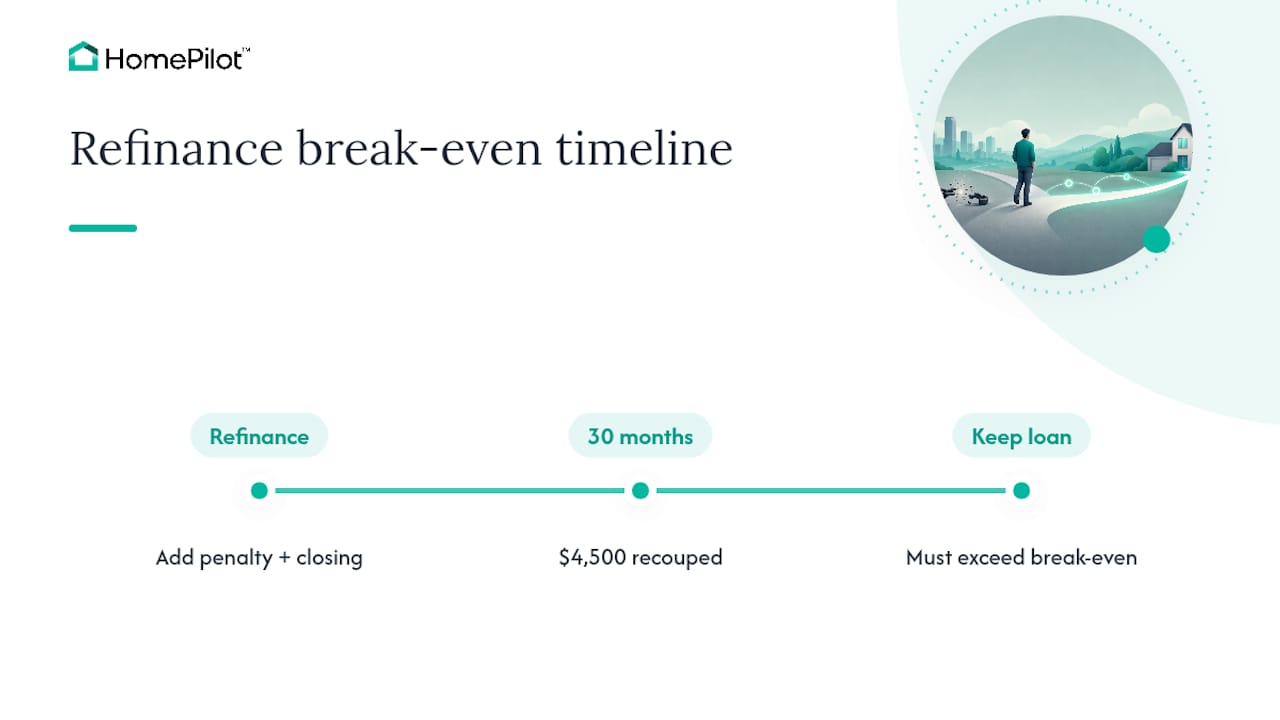
If refinancing saves you $150 a month and the combined penalty and closing costs run $4,500, you’d need 30 months to recoup the cost. Whether that’s worth it depends entirely on how long you plan to keep the loan. HomePilot Mortgage’s refinance break-even calculator and broader mortgage calculators run this math for your actual numbers rather than a rough estimate.
It’s the break-even math against your new rate that decides whether it’s worth paying.
Federal Rules That Cap and Limit Prepayment Penalties
Federal law doesn’t ban prepayment penalties outright, but it fences them in tightly. Under Regulation Z, 12 C.F.R. § 1026.43, a penalty on a qualifying mortgage can’t exceed 2% of the outstanding balance during the first two years of the loan, drops to a 1% cap in year three, and disappears entirely after that. No penalty is legally allowed on a qualified mortgage past the three-year mark, period.
There’s a second layer of protection built into that same rule: eligibility. Penalties are only permitted on loans that meet the qualified mortgage standard tied to the Ability-to-Repay framework, and the CFPB’s compliance guidance spells out which loans qualify. Higher-priced loans and high-cost loans under HOEPA are excluded from allowing penalties at all.
Several loan categories skip the penalty question entirely because they prohibit the fee by program rule:
- FHA-insured mortgages, per HUD program guidance, don’t permit prepayment penalties
- VA loans carry the same prohibition
- USDA loans follow suit
- Federal credit-union loans are generally barred from charging one
One more protection that catches borrowers off guard in the best way: if a lender offers you a loan with a prepayment penalty, it’s required to also offer you a comparable no-penalty version you’d likely qualify for. That’s a real negotiating lever at the application stage, not just a footnote in the regulation.
Does Your State Ban or Limit Mortgage Prepayment Fees?
Federal law sets the outer boundary, but plenty of states go further. A number of states restrict or prohibit prepayment penalties on residential mortgages entirely, and the rules differ enough from state to state that you can’t assume your home state follows the federal cap by default. A legislative research summary from Connecticut lays out just how much variation exists across the country, from outright bans to narrower carve-outs tied to loan size or lender type.
Checking your own state’s rule takes three steps:
- Look up your state’s statutes or banking regulator page for mortgage lending rules specific to prepayment fees.
- Contact your state’s consumer protection office or attorney general’s office if the statute language is unclear or you suspect a violation.
- Verify your lender’s license and complaint history through NMLS Consumer Access, which publishes registration status for mortgage companies operating in your state.
State protections can beat federal caps outright. Some states ban the fee on all residential first mortgages regardless of what Regulation Z would otherwise allow, so a call to your state regulator can sometimes eliminate a fee you assumed you were stuck paying.
Selling, Refinancing, or Paying Down Early: Which Move Makes Sense?
A prepayment penalty doesn’t automatically mean you should sit still. It just changes the math on three decisions homeowners face regularly.
- Selling or moving. If a job transfer or divorce forces a sale inside the penalty window, the fee usually becomes just another line item on the closing statement, not a reason to delay a move you need to make. Readers weighing a sale against carrying the loan longer may find this comparison of forbearance and deferment options useful for understanding what alternatives exist before listing.
- Refinancing for a lower rate. Run the break-even math first. If the penalty plus closing costs pay for themselves within a timeframe that matches how long you’ll keep the new loan, refinancing still wins.
- Aggressive early payoff. Confirm your annual prepayment privilege limit before dumping a windfall into principal. Staying under that threshold avoids the fee entirely.
Before signing anything with a penalty clause, ask the lender directly for the no-penalty alternative it’s required to offer, or ask whether the fee can be bought out or reduced. Timing a refinance for just after the three-year cutoff, when the penalty legally disappears, is sometimes the simplest fix of all.
How HomePilot Mortgage Helps You Evaluate a Penalty-Bearing Loan
Comparing a loan with a prepayment penalty against a clean alternative isn’t something most borrowers do with confidence, mostly because the fee structures are inconsistent from lender to lender. HomePilot Mortgage’s free loan estimate review checks your actual Loan Estimate against wholesale pricing, flagging penalty clauses and showing what a no-penalty version of the same loan would cost over time. Pair that with the mortgage calculators built for break-even math, and you get a real side-by-side instead of a guess.
Some mortgage brokers source rates from numerous lenders across multiple states and can often surface loan structures that skip the penalty question entirely. Availability still depends on your state and the specific loan product, so confirm terms and any local restrictions before you commit to one path over another.
A Practical Take on Paying the Penalty vs. Waiting It Out
Paying a prepayment penalty makes sense when the math clearly favors it: a refinance that saves real money over the time you’ll actually hold the loan, or a sale forced by life circumstances you can’t control anyway. It stops making sense when someone assumes a penalty is unavoidable without ever reading the addendum to their own note.
Read your documents before you decide anything. Run the break-even numbers against your actual timeline, not a rough guess. And always ask your lender for the no-penalty alternative they’re required to offer. Most of the fear around these fees comes from not knowing which of the three calculation methods applies to your specific loan, not from the fee itself.
Jack
Compare Your Loan Before You Assume You’re Stuck With a Penalty
Some services provide direct access to wholesale pricing from many lenders, allowing you to see whether a no-penalty alternative beats the loan you’re currently holding, without a hard credit pull just to get a quote.
If your Loan Estimate includes a prepayment clause you don’t fully understand, the free loan estimate review walks through it line by line and shows what a comparable no-penalty structure would cost instead. HomePilot Mortgage currently serves borrowers in Arizona, California, Colorado, Florida, and Texas, and eligibility depends on your state and loan type, so confirm details before moving forward. Arizona homeowners can start by checking today’s wholesale rates directly, while anyone comparing refinance timing against a penalty window can run the numbers with the refinance break-even calculator. Getting a quote takes about three minutes and won’t affect your credit.
This article is general information, not a substitute for advice from a qualified financial advisor. Consult a qualified financial professional about your own circumstances before acting on anything here.
Sources
- Consumer Financial Protection Bureau, What is a prepayment penalty?
- Wex, Prepayment penalty (Legal Information Institute)
- State Mortgage Prepayment Penalty Laws, Connecticut General Assembly
Recommended
HomePilot Mortgage, NMLS #2752340, is a licensed mortgage broker in Arizona, California, Colorado, Florida, and Texas. Equal Housing Lender. This article is general information, not a loan offer or a commitment to lend. Rates and program terms change daily and depend on credit, loan amount, and county. HomePilot Mortgage is a private company, not affiliated with or endorsed by the Department of Veterans Affairs, HUD, or any government agency.