US Refinance to Remove a Co Borrower: 2%–6% Costs, Use Break Even Tool
· By the HomePilot team · Reviewed by a licensed loan officer · Company NMLS #2752340

US Refinance to Remove a Co Borrower: 2%, 6% Costs, Use Break Even Tool

Yes: in the United States, you can generally remove a co-borrower by refinancing the mortgage into your name only, provided the remaining borrower can qualify on their own. Lender approval is required, and the process only removes them from loan liability, not necessarily from the property deed. If a solo refinance isn’t possible right now, alternatives like loan assumption, release of liability, or selling the home exist, but they’re far less common and harder to arrange.
TL;DR:
- Removing a co-borrower usually requires refinancing into the remaining borrower’s name, which involves lender approval and costs between 2% and 6% of the loan amount.
- Lenders evaluate the remaining borrower’s credit score, income, and equity to determine eligibility for a solo refinance, often requiring documentation such as pay stubs and tax returns.
- Refinancing does not automatically remove someone from the property deed, so a separate legal action like a quitclaim deed may be necessary to fully sever ownership rights.
- Alternatives such as loan assumption, release of liability, or sale are possible but less common and often require lender approval or court proceedings.
- The refinancing process generally takes one to two months, and borrowers should verify that the savings outweigh closing costs before proceeding.
Table of Contents
- What Refinancing Changes Versus Changing the Deed
- Eligibility and Lender Requirements to Refinance Solo
- Step-by-Step Refinance Checklist to Remove a Co-Borrower
- Alternatives to Refinancing and When They Apply
- Costs and Timeline to Expect When Refinancing to Remove a Co-Borrower
- If You Can’t Qualify Alone: Practical Next Steps
- Confirming the Co-Borrower Is Released After Refinance
- The HomePilot Perspective on Removing a Co-Borrower
- How HomePilot Helps You Refinance Without a Co-Borrower
- Sources
- FAQ
What Refinancing Changes Versus Changing the Deed
Refinancing replaces your existing joint mortgage with a brand-new loan in one person’s name. That new loan pays off the old one in full, and the cosigner’s legal obligation on the debt ends the moment the refinance closes. It handles who owes the money. It does nothing for who owns the house.
Ownership lives on the deed, not the note. If both names are on the title, refinancing alone leaves them there. Removing a co-owner from the deed requires a separate legal step, typically a quitclaim deed or a warranty deed transferring their interest to you. Skip that step and you can end up with a strange situation: one person financially responsible for the loan while someone else still legally co-owns the home.

Both moves matter if you want a clean break. A departing co-borrower who signs off the loan but stays on the title still has a legal claim to the property. Handle the deed and the note together, or you’re only solving half the problem.
Eligibility and Lender Requirements to Refinance Solo
Lenders don’t remove a name from a mortgage as a favor. They evaluate the remaining borrower as if they were applying for a brand-new loan, because that’s essentially what’s happening.
Statistic to know: Closing costs on a refinance typically run 2% to 6% of the loan amount, a range that shapes whether solo refinancing actually pencils out once you’ve confirmed you qualify.
Underwriters generally look at:
- Credit score and payment history. A consistent record of on-time payments on the existing mortgage is one of the strongest signals lenders weigh when deciding whether to approve a solo refinance or cosigner release.
- Income and employment. You’ll need to show stable income through pay stubs, W-2s, or tax returns, and your debt-to-income ratio has to fall within the lender’s limits once the co-borrower’s income disappears from the equation.
- Equity and loan-to-value. Lenders check how much equity sits in the home; thin equity can trigger private mortgage insurance or limit your loan options.
- Program-specific rules. Conventional, FHA, VA, and USDA loans each carry their own overlays; USDA’s single-family housing programs in particular have distinct assumption and streamline rules worth checking early.
- Documentation. Pay stubs, tax returns, bank statements, and a current mortgage statement should all be ready before you apply.
If your income alone doesn’t clear the bar, credit unions or non-QM programs sometimes offer more flexible underwriting than a standard conventional lender.
Step-by-Step Refinance Checklist to Remove a Co-Borrower
Removing a co-borrower through refinancing follows a fairly predictable sequence. Here’s how it typically plays out:
- Run the numbers first. Use a refinance break-even calculator to see how long it takes closing costs to pay for themselves, and confirm your equity position before you commit to anything.
- Pull your credit and gather documents. Collect W-2s, recent pay stubs, two years of tax returns if you’re self-employed, and two to three months of bank statements.
- Request quotes or start an application. HomePilot lets you get a no-hard-pull quote in minutes, so you can compare pricing across 40+ wholesale lenders before your credit takes a single hit.
- Complete appraisal and underwriting. Respond to conditions quickly. Underwriters routinely ask for a follow-up letter or updated document, and slow responses are the most common reason closings drag past 45 days.
- Close and confirm the payoff. At closing, get your closing disclosure and confirm the old loan shows paid in full. Ask for written evidence that your co-borrower is released from liability.
Pro Tip: Order your own credit report before you apply. An old collection account or a reporting error can quietly push your debt-to-income ratio over the limit, and catching it early saves weeks.
Alternatives to Refinancing and When They Apply
Refinancing solves most cases, but it isn’t the only route off a shared loan. When it’s not workable, a few other paths exist, each with real limitations.
- Release of liability. Some lenders will remove a co-borrower from an existing loan without a full refinance, but this is entirely lender-controlled and rarely granted without the same strict income and credit checks a refinance would require.
- Loan assumption. FHA, VA, and USDA loans sometimes allow a qualified borrower to assume the existing loan under specific circumstances. Conventional loans almost never allow this.
- Deed transfer (quitclaim). A quitclaim deed removes someone’s ownership interest in the property, but it does not touch loan liability. The person who signed the original note is still on the hook unless the lender separately releases them.
- Sale of the home. If refinancing and assumption both fail, selling the property is the most definitive way to end shared loan liability for good.
Divorce decrees complicate this more than people expect. A court can order one spouse to refinance the home, but the court has no authority to force a lender to approve that loan. Underwriting standards still control the outcome, decree or no decree.
Costs and Timeline to Expect When Refinancing to Remove a Co-Borrower
Budget for closing costs in the range of 2% to 6% of your loan balance. That covers the appraisal, title work, origination charges, and recording fees, and it’s the single biggest factor in whether removing a co-borrower actually saves money versus other options.
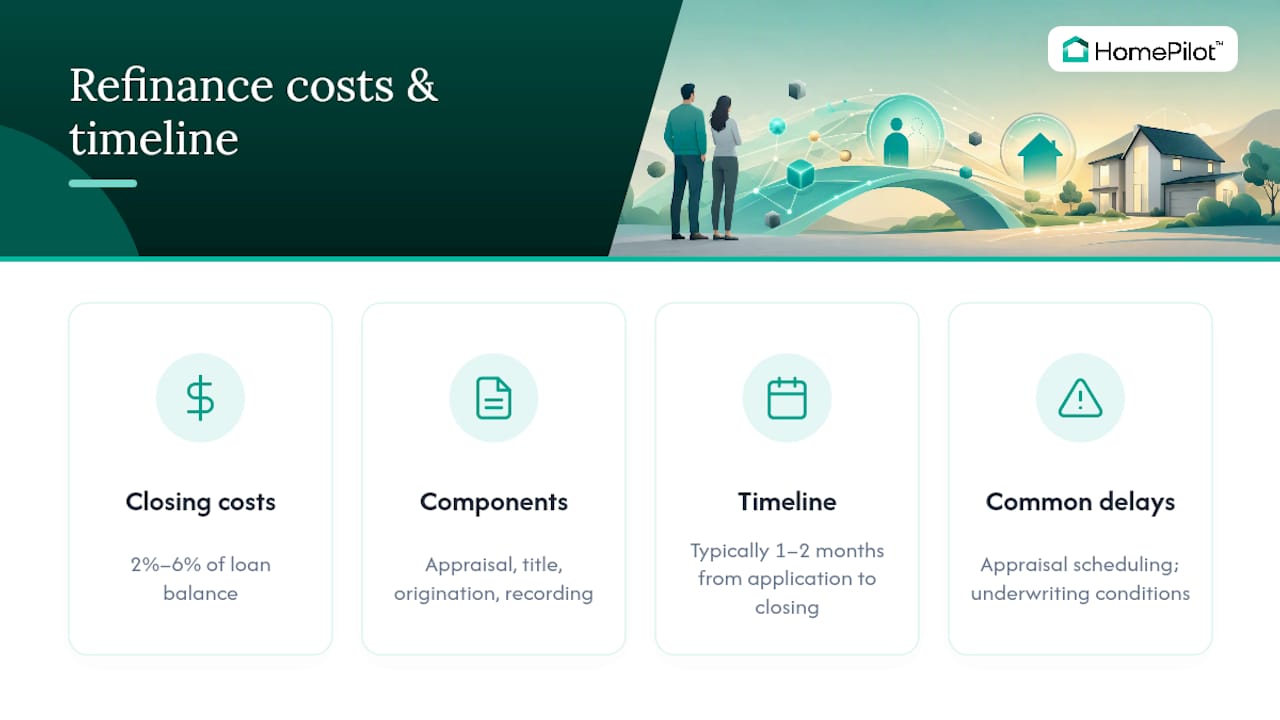
Timeline-wise, a cooperative refinance usually takes roughly one to two months from application to closing. Appraisal scheduling and underwriting conditions are the two most common causes of delay; a home that’s hard to access for an appraiser or a borrower slow to return paperwork can push closing well past that window. Assumptions and lender-granted releases often take longer, since they require manual, case-by-case review rather than the standardized process a refinance follows.
Some borrowers roll closing costs into the new loan balance instead of paying cash at closing. That works, but it means paying interest on those costs for the life of the loan, so it’s worth running through a calculator before deciding.
If You Can’t Qualify Alone: Practical Next Steps
Not qualifying solo today doesn’t mean the door is closed permanently. A few realistic paths forward:
Short term, focus on the fundamentals: pay down revolving debt to lower your DTI, avoid new credit inquiries, and let equity build if home values are rising in your area. Even a few months of improvement can shift an application from “denied” to “approved.”
If time isn’t on your side, a negotiated buyout, a sale, or trading other marital assets during a divorce settlement can resolve the loan question without waiting on your credit to catch up. This is often where a family law attorney or financial counselor earns their fee. Get professional guidance before signing anything that changes who’s financially responsible for the home.
Whatever temporary arrangement you land on, write it down. A signed agreement covering who pays what and when protects both parties if the situation drags on longer than expected.
Confirming the Co-Borrower Is Released After Refinance
Closing the new loan isn’t the finish line. Get your closing disclosure and payoff statement in writing, both should clearly show the original joint loan was paid in full. Then request written confirmation from the lender that the departing borrower carries no further liability on that account.
After that, operational cleanup matters just as much as the paperwork: confirm the old account shows as closed and paid on both parties’ credit reports within a billing cycle or two, and if ownership changed hands, make sure the new deed gets recorded with the county and keep a copy. Removing someone from title is a separate action from removing them from the loan, and the lender remains the deciding authority on loan liability until that loan is actually paid off or refinanced.
The HomePilot Perspective on Removing a Co-Borrower
We think refinancing is the right first move for most people trying to remove a co-borrower, but only after the numbers actually make sense. Too many borrowers rush into an application before checking whether the closing costs will outweigh the benefit of getting a name off the loan.
That’s why we push people toward the refinance break-even calculator before anything else. We compare pricing across 40+ wholesale lenders and publish live rates against the national average every business day, so you’re not guessing whether solo refinancing is realistic for your situation. Start with a no-hard-pull quote, run the math, then decide.
, The HomePilot Team
How HomePilot Helps You Refinance Without a Co-Borrower
HomePilot is the alternative to shopping bank by bank for a solo refinance: instead of one institution’s rate sheet, we price your file across 40+ wholesale lenders at once, with $0 lender fees on many files and a published $500 Best Price Guarantee on eligible offers (terms apply).

Start with the refinance break-even calculator to see whether removing a co-borrower actually pencils out at today’s pricing, check live rates against the national average any business day, or request a free loan estimate review if you’ve already got a competing offer in hand. Purchases and refinances through HomePilot typically move from accepted terms to closing in about 20 days once the file is complete. Getting a quote takes minutes and starts with no hard credit pull.
Sources
Program specifics for government-backed loans are worth checking directly. The USDA’s single-family housing programs page covers assumption and eligibility rules that vary from conventional lending. To verify licensing on any mortgage broker, NMLS Consumer Access is the official registry. And if a sale becomes the more practical route out of a joint loan, resources like avoiding foreclosure through a fast home sale walk through that process in more detail.
This article is general information, not a substitute for advice from a qualified financial advisor. Consult a qualified financial professional about your own circumstances before acting on anything here.
FAQ
How Do I Remove a Co-Borrower From a Mortgage Loan?
Refinance the mortgage into the remaining borrower’s name alone; the new loan pays off the joint loan and legally releases the co-borrower once it closes.
Can You Refinance and Remove a Cosigner?
Yes. Refinancing without a cosigner is possible as long as the remaining borrower qualifies alone on credit, income, and debt-to-income ratio.
Can I Refinance My Car Loan to Remove a Cosigner?
The same basic principle applies to auto loans: refinancing into one borrower’s name pays off the joint loan and removes the cosigner’s obligation, though approval depends on that borrower qualifying solo with the auto lender.
Can I Get My Ex-Spouse Off My Mortgage Without Refinancing?
It’s possible through a lender-approved release of liability or a loan assumption, but both are far less common than refinancing and depend entirely on the lender’s willingness to approve them.
How Much Does It Cost to Refinance to Remove a Co-Borrower?
Expect closing costs of roughly 2% to 6% of the loan amount, covering the appraisal, title work, origination, and recording fees.
Recommended
- Mortgage Calculators
- Keep Your Mortgage. Access Your Equity.
- Free Loan Estimate Review, Compare Your LE to Wholesale
HomePilot Mortgage, NMLS #2752340, is a licensed mortgage broker in Arizona, California, Colorado, Florida, and Texas. Equal Housing Lender. This article is general information, not a loan offer or a commitment to lend. Rates and program terms change daily and depend on credit, loan amount, and county. HomePilot Mortgage is a private company, not affiliated with or endorsed by the Department of Veterans Affairs, HUD, or any government agency.