U.S. Self Employed Mortgage Requirements: When to Use Bank Statement or 1099 Loans
· By the HomePilot team · Reviewed by a licensed loan officer · Company NMLS #2752340

Most self-employed borrowers qualify through one of two paths: the conventional route, built on two years of tax returns and a formal cash-flow analysis, or an alternative bank-statement or 1099 non-QM path when tax returns understate real income. Lenders average your net taxable income over two years, add back specific non-cash deductions, then divide by 24. Credit score, down payment size, and cash reserves influence which programs may be available to applicants.
TL;DR:
- A written cash-flow analysis is essential for all self-employed mortgage applications, regardless of income amount or documentation path used.
- Lenders generally require two years of tax returns, IRS transcripts, business documents, and proof of funds to accurately calculate qualifying income.
- Alternative paths like bank-statement or 1099-only loans use different income verification methods, with higher rates and stricter reserve requirements.
- Strong credit scores above 700 and a substantial down payment of at least 10-20% increase approval chances for self-employed borrowers.
- Early CPA consultation and thorough preparation of documentation significantly reduce delays and improve chances of mortgage approval.
Table of Contents
- Understanding Self-Employed Mortgage Requirements: Who Qualifies and How
- The Exact Documents Lenders Request for a 1099 or Self-Employment Home Loan
- How Lenders Calculate Your Qualifying Income
- Bank-Statement, 1099-Only, and Non-QM Loans Explained
- Credit Score, Down Payment, and Reserve Thresholds That Decide Program Access
- Choosing a Lender Who Actually Understands Self-Employment Income
- Building Your Self-Employment Home Loan File Step by Step
- A Practical Take on Getting Approved While Self-Employed
- How HomePilot Mortgage Helps Self-Employed Borrowers Move Faster
- Sources
Understanding Self-Employed Mortgage Requirements: Who Qualifies and How
Lenders don’t use the same definition of “self-employed” you’d find in a dictionary. If you own 25% or more of a business, file a Schedule C, earn income reported on 1099s, or work gig platforms without a W-2, underwriters treat you the same way: as a business, not an employee. That distinction changes almost everything about how your file gets built.
The starting point for nearly every conventional loan is two years of documented self-employment. Underwriters want to see a pattern, not a single good year. But two notable exceptions exist. If you have at least a five-year history in the same line of work and can show a one-year track record after a career transition, some lenders will work with a single year of returns. The other exception applies when you moved from W-2 employment into a closely related self-employed role, where your prior salaried history can supplement a shorter self-employment record.
Underneath both scenarios sits a requirement most borrowers never hear about until it’s already slowing down their file: Fannie Mae requires lenders to complete a written cash-flow analysis for every self-employed applicant, often using Form 1084. This isn’t a rubber stamp. The underwriter is evaluating:
- Whether your income is stable or trending up, flat, or declining year over year
- Whether the business itself looks viable, meaning it has real revenue, real expenses, and a plausible reason to keep operating
- Whether your business structure (sole proprietorship, partnership, S-Corp, LLC) changes how income flows through to your personal return
- Whether a sudden spike or drop in income needs an explanation before the file can move forward
That written analysis is the real engine behind self-employed mortgage requirements. Everything else, the documents you gather, the math on your qualifying income, the choice between a conventional loan and a non-QM alternative, exists to feed that analysis. Business type matters here too. An S-Corp shareholder’s K-1 income gets treated differently than a sole proprietor’s Schedule C net profit, and partnerships add another layer because underwriters have to verify your share of the business didn’t change year to year in a way that would distort the trend.
The Exact Documents Lenders Request for a 1099 or Self-Employment Home Loan
Every self-employed mortgage requirements checklist starts in roughly the same place, whether you’re applying through a conventional lender or exploring a 1099-only path. Gather these in this order:
- Two years of signed federal tax returns, including all schedules. This means your full 1040, Schedule C for sole proprietors, or K-1s and corporate returns (1120S or 1065) if you operate as an S-Corp or partnership.
- IRS tax transcripts. Most lenders now pull these directly or ask you to request them through the IRS Self-Employed Individuals Tax Center as a way to verify your returns match what’s on file with the government.
- 1099s covering the past one to two years if you’re pursuing a 1099-only or non-QM path.
- 12 to 24 months of business and personal bank statements, required for bank-statement loan programs and often requested even on conventional files to verify cash flow and reserves.
- A CPA-prepared or CPA-reviewed year-to-date profit and loss statement, plus a current balance sheet. Lenders lean on these heavily when your most recent tax year isn’t reflected yet in filed returns.
- Business licenses or registration documents proving your business is active and legally operating.
- Client contracts or signed invoices, especially useful if you’re a contractor or creator whose income comes from a handful of large clients rather than steady payroll.
- Proof of down payment source and reserve funds, typically two to three months of statements showing where the money came from and that it’s been seasoned in your account.
Missing even one of these can stall underwriting for weeks. Gathering the full stack before you apply is the single biggest time-saver in the entire process.
How Lenders Calculate Your Qualifying Income
The math behind self-employed mortgage requirements is more mechanical than most borrowers expect, and understanding it can change how you plan your taxes next year.
Underwriters start with your net income, typically Schedule C Line 31, or your share of net income from a K-1 for partnerships and S-Corps. From there, they add back specific expenses that reduced your taxable income on paper but didn’t actually leave your bank account:
- Depreciation
- Depletion
- Amortization
- Business-use-of-home deductions
- Certain one-time or non-recurring expenses, when documented
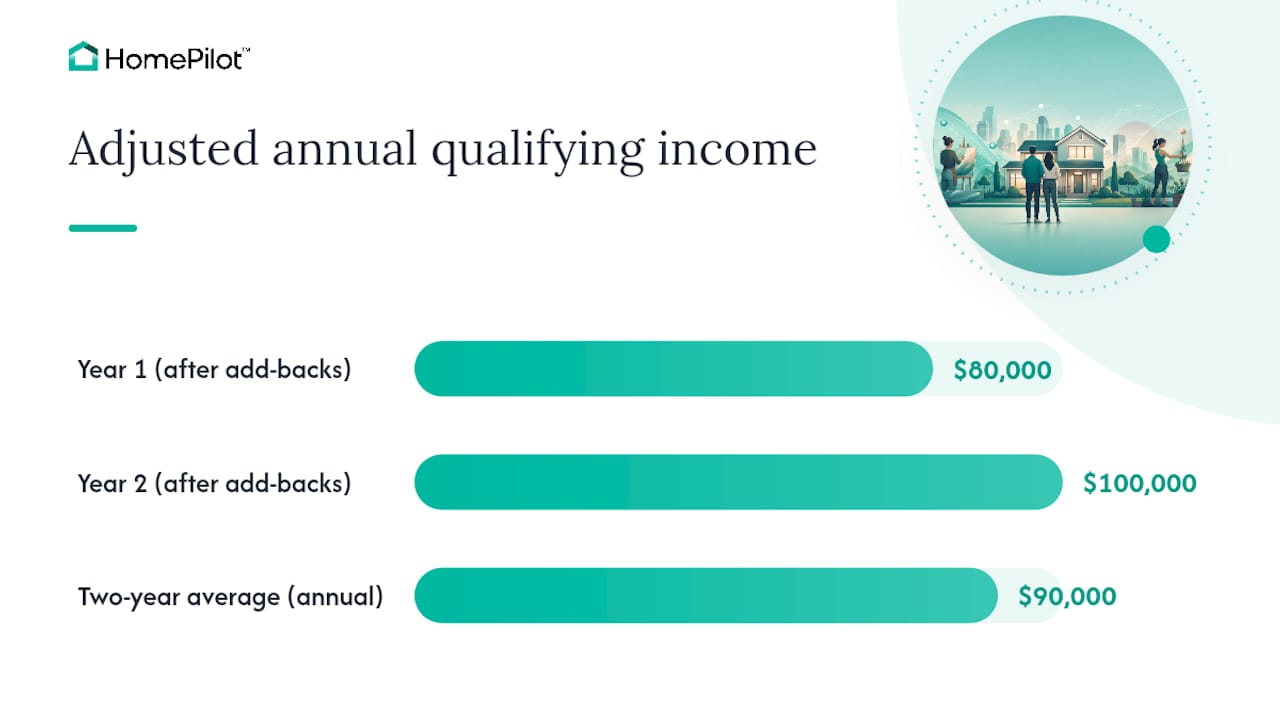
Once add-backs are applied for each of the two most recent tax years, the lender averages the two totals and divides by 24 to get your monthly qualifying income.
Here’s a simplified example. Say your Schedule C shows net income of $70,000 in Year 1 and $90,000 in Year 2. After adding back $10,000 in depreciation each year, your adjusted totals are $80,000 and $100,000. Average those two years and you get $90,000, divided by 24 months, for a qualifying income of $3,750 a month.
Now flip it. If you’d aggressively written off meals, entertainment, and a large Section 179 equipment deduction to minimize your tax bill, your net income on paper might look far lower, even though your actual cash flow was strong. That’s the tradeoff self-employed borrowers face every tax season: minimize taxes and you may also minimize your mortgage eligibility. A CPA-prepared profit and loss statement can sometimes document that certain deductions were truly one-time, giving underwriters grounds to add them back too.
Pro Tip: Talk to your CPA about mortgage plans before you file next year’s return. A conversation in January about which deductions to take can be worth more to your approval odds than any amount of shopping around for rates in June.
Bank-Statement, 1099-Only, and Non-QM Loans Explained
When your tax returns don’t reflect your real earning power, and for many self-employed people they don’t, alternative documentation paths exist specifically to bridge that gap.
Bank-statement loans use 12 to 24 months of business or personal bank deposits instead of tax returns to establish income. Lenders typically apply a default expense ratio, commonly around 50%, meaning they assume half your deposits cover business expenses and count the rest as income. If that default ratio undercounts your actual profitability, a CPA-certified expense ratio letter stating your real expense percentage can unlock meaningfully more qualifying income than the lender’s generic assumption.

1099-only programs work well for contractors, gig workers, and creators who receive most of their income on 1099s rather than through payroll. These programs commonly count around 90% of gross 1099 income as qualifying income, skipping the net-income math entirely. An Uber driver, a freelance designer, or a creator earning through brand deals and platform payouts can often qualify faster this way than by trying to make a heavily deducted Schedule C work.
Both paths fall under non-QM lending, which means:
- Interest rates tend to run higher than conventional pricing
- Reserve requirements are often steeper
- Maximum loan-to-value ratios are usually more conservative
The tradeoff is real but so is the benefit. If your tax returns tell a distorted story, these programs let your actual cash flow speak instead.
Credit Score, Down Payment, and Reserve Thresholds That Decide Program Access
Numbers, not narratives, decide which loan programs are even available to you. A few thresholds carry outsized weight for self-employed applicants specifically, since lenders often ask for more cushion when income documentation is less conventional.
- Credit score: A baseline conventional self-employed loan often needs a score in the mid-600s, but the best pricing tiers usually start around 700 and above, with non-QM and bank-statement programs sometimes accepting scores in the low-to-mid 600s at a rate premium.
- Down payment: Conventional loans can start as low as 3 to 5% down for well-qualified borrowers, FHA around 3.5%, while bank-statement and 1099 non-QM programs typically require 10 to 20% down.
- Private mortgage insurance: Anytime your down payment falls below 20% on a conventional loan, expect PMI added to your monthly payment until you build enough equity.
- Reserves: Most self-employed files require two to six months of housing payments in verified liquid reserves, and non-QM programs often ask for more.
Self-employed borrowers with strong reserves and higher credit scores tend to get approved more easily than those with weaker credit and minimal reserves. Reserves are the lever you control most directly, and they’re often the fastest way to offset a thinner income history.
Choosing a Lender Who Actually Understands Self-Employment Income
Not every loan officer handles self-employed files well, and picking the wrong one costs you time you don’t get back.
- Ask how often they close self-employed or 1099-only files. A lender who does this weekly will spot problems in your documents before underwriting does.
- Ask whether they use IRS transcripts routinely. Lenders who skip this step sometimes discover discrepancies late, which delays closing.
- Ask how they handle CPA letters and add-backs. A lender who dismisses CPA documentation outright may be applying overly conservative default assumptions.
- Ask for a sample list of conditions from a recently closed self-employed file. This tells you what to expect and how organized their process really is.
Red flags worth walking away from: vague answers about documentation requirements, refusal to explain how they calculate qualifying income, or hesitation when you ask about Form 1084 and the written cash-flow analysis.
Pro Tip: If a loan officer can’t explain the difference between a bank-statement loan and a 1099-only program in plain language, keep shopping. That gap in knowledge usually shows up later as a surprise condition or a rate you didn’t expect.
Building Your Self-Employment Home Loan File Step by Step
Start now, not after you find a house. The paperwork side of self-employed mortgage requirements takes longer to assemble than most borrowers expect.
- This week: Pull your last two years of signed tax returns, gather 1099s, and identify exactly where your down payment funds will come from.
- Within 30 days: Request IRS transcripts, start collecting client contracts or invoices, and confirm your reserve accounts are seasoned and documented.
- Within 60 to 90 days: Commission a CPA-prepared year-to-date profit and loss statement and balance sheet, especially if your most recent tax year isn’t reflected in filed returns yet.
- Expect four to six weeks from a complete application to a clear-to-close, longer if underwriting comes back with conditions tied to income documentation or business verification.
The single most common delay: borrowers who wait until they’re under contract to request a CPA letter. Order it early.
A Practical Take on Getting Approved While Self-Employed
The biggest mistake I see self-employed borrowers make isn’t a weak credit score or an unusual business structure. It’s waiting to talk to a CPA about their mortgage plans until after they’ve already filed taxes to minimize their bill. Get a CPA-prepared P&L early and document recurring revenue wherever you can. One borrower I’ve seen this pattern repeat with: a contractor who wrote off nearly everything possible one year, then had to spend three extra weeks proving legitimate one-time expenses to get those numbers added back. Give yourself a realistic runway, usually two to three months of prep before you apply, and the process moves far more smoothly than the horror stories suggest.
Jack
How HomePilot Mortgage Helps Self-Employed Borrowers Move Faster
HomePilot gives self-employed borrowers something most retail lenders don’t: direct access to wholesale rates from over 40 lenders, so you’re not stuck with whatever single underwriting guideline one bank happens to prefer. That matters enormously here, because one lender’s overlay on bank-statement loans or 1099 income can be far stricter than another’s, and comparing options across dozens of lenders at once is the fastest way to find the program that actually fits your file.
You can get a quote in about three minutes without a Social Security number or a hard credit pull, which means you can test both the conventional path and an alt-doc route without any impact to your credit while you figure out which documentation strategy makes sense. HomePilot’s mortgage calculators help you model payments under different down payment and rate scenarios, and if you already have a Loan Estimate from another lender, the free Loan Estimate review compares it against live wholesale pricing so you know whether you’re leaving money on the table. Ready to see where you stand? Check today’s wholesale rates for your state and start the conversation.
This article is general information, not a substitute for advice from a qualified financial advisor. Consult a qualified financial professional about your own circumstances before acting on anything here.
Sources
- Underwriting factors and documentation for a self-employed borrower | Fannie Mae
- What is private mortgage insurance? | Consumer Financial Protection Bureau