36 Month Break Even: When a VA Streamline Refinance Pays for Veterans
· By the HomePilot team · Reviewed by a licensed loan officer · Company NMLS #2752340

If you already have a VA-backed loan and rates have dropped since you closed, a VA streamline refinance can lower your payment with minimal paperwork and usually no appraisal. It only makes sense if you can recoup the closing costs within 36 months, and it won’t hand you cash out. Your next move: run the break-even math before you talk to a single lender.
TL;DR:
- Veterans must ensure their closing costs can be recouped within 36 months through payment savings; otherwise, the refinance may not meet VA guidelines.
- Most IRRRLs do not require appraisals or credit pulls, but individual lenders often add their own conditions that could complicate approval.
- The refinance is only beneficial if it lowers the monthly payment enough to recover closing costs within the 36-month break-even period.
- Comparing offers from multiple lenders and verifying the net tangible benefit and recoupment calculations reduces the risk of costly mistakes.
- Beware of lenders pushing unnecessary fees, vague fee breakdowns, or promises of cash-back, which may violate VA or CFPB warnings.
Table of Contents
- What Is a VA Streamline Refinance (IRRRL)?
- IRRRL Requirements: Eligibility, Seasoning, and the Net Tangible Benefit Test
- The Real Cost of an IRRRL: Funding Fee and the 36-Month Break-Even Rule
- How to Apply for a VA IRRRL: A Step-by-Step Checklist
- How to Shop VA Lenders and Spot Refinance Red Flags
- Why Most Veterans Get the IRRRL Math Wrong
- Compare Your IRRRL Options Before You Commit
What Is a VA Streamline Refinance (IRRRL)?
The Interest Rate Reduction Refinance Loan, or IRRRL, refinances one VA-backed loan into another VA-backed loan. Nothing else qualifies. If your current mortgage is FHA, conventional, or USDA, you can’t use an IRRRL to convert it, no matter how good your VA eligibility looks otherwise. It’s a rate-and-term product, not a cash-out tool.
That narrow focus is what makes it fast. Most IRRRLs skip the appraisal and skip full income underwriting, which is why veterans call it a “streamline” in the first place. Common reasons to use one:
- Lower your interest rate and monthly payment
- Convert an adjustable-rate VA loan to a fixed rate before it resets
- Shorten your loan term to build equity faster and cut lifetime interest
- Remove a co-borrower from the loan under specific conditions
One catch worth flagging up front: the VA doesn’t require appraisals or credit pulls for most IRRRLs, but individual lenders often add their own conditions anyway. A lender overlay can mean a credit check or property valuation even when federal rules say it isn’t necessary. Ask directly before you apply.
IRRRL Requirements: Eligibility, Seasoning, and the Net Tangible Benefit Test
You need an existing VA-backed loan to start. The VA also requires that the home was, or currently is, your primary residence, and you’ll typically certify occupancy as part of the file.
Seasoning is where a lot of applications stall. Two clocks run simultaneously, and both must clear:
- At least 210 days must have passed since your first payment on the current loan
- You must have made six consecutive monthly payments on time
Miss either threshold and the lender can’t close, regardless of how attractive the new rate looks.
Then comes net tangible benefit, or NTB, the requirement that the refinance actually helps you rather than just resetting your loan for a lender’s benefit. VA Circular 26-19-22 spells out the standard tests: a lower interest rate typically satisfies NTB on its own, and specific carve-outs exist for converting an ARM to a fixed rate, shortening your term, or removing a borrower from the note, even when the rate itself goes up. Your lender should show you this math in writing, not just tell you it checks out.
Your Certificate of Eligibility (COE) from your original VA loan generally carries over, and most lenders can pull it electronically rather than asking you to track down paperwork.
The Real Cost of an IRRRL: Funding Fee and the 36-Month Break-Even Rule
Closing costs on an IRRRL typically include the VA funding fee, title and recording charges, and standard lender fees. The good news: these costs can usually be rolled into the new loan balance rather than paid out of pocket, and IRRRL funding fees run lower than purchase-loan fees. Veterans with a service-connected disability rating are often exempt from the funding fee entirely, which changes the math significantly in their favor.
But rolling costs into the loan isn’t free. It raises your principal balance, and that means more interest paid over the life of the loan even as your monthly payment drops.
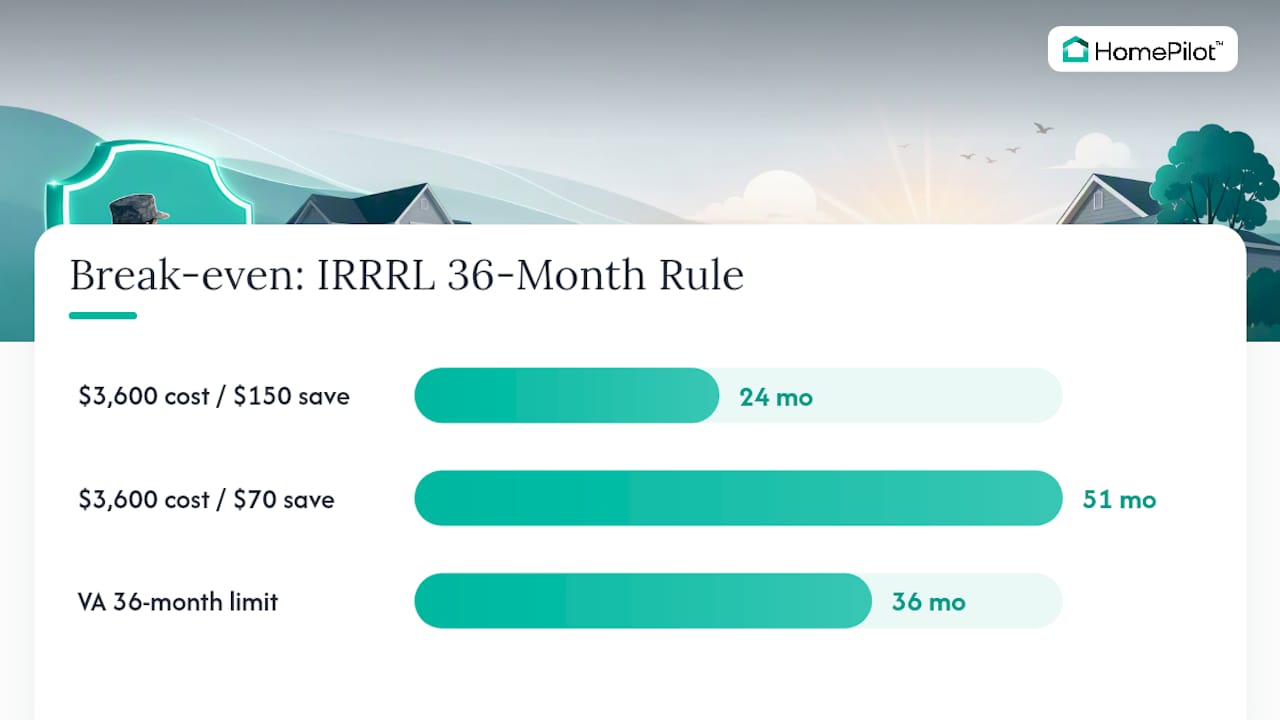
Statistic Callout: VA policy under Circular 26-19-22 requires that closing costs and fees financed into an IRRRL be recouped through payment savings within 36 months. If the math doesn’t clear that bar, the loan doesn’t meet VA guidelines.
Here’s how to run it:
- Add up every dollar of closing costs, including the funding fee if you’re financing it.
- Calculate your monthly payment savings (old payment minus new payment).
- Divide total costs by monthly savings to get your break-even point in months.
Say your closing costs total $3,600 and your new payment saves you $150 a month. That’s a 24-month break-even, well inside the 36-month ceiling. But if the same $3,600 only saves you $70 a month, you’re looking at 51 months to recoup, which fails the VA’s own test. A lender pushing that loan through anyway is a lender you should walk away from.
How to Apply for a VA IRRRL: A Step-by-Step Checklist
The process moves faster than a purchase loan, but skipping steps costs you leverage. Work through it in this order:
- Confirm your COE is on file, or ask your lender to retrieve it electronically.
- Pull your current loan details: balance, rate, term remaining, and your last twelve months of statements.
- Request quotes from at least three lenders, and ask each for a written VA comparison statement showing old versus new terms.
- Have every lender show you their NTB calculation and their 36-month recoupment math, not just a summary sheet.
- Run your own break-even numbers using a refinance calculator and compare financed costs against any lender credits offered.
- Lock your rate, sign disclosures, and move to closing, which for most IRRRLs runs two to four weeks from application.
Pro Tip: Ask each lender the exact same set of questions in the exact same order. Inconsistent answers, especially around fees or the NTB math, are usually the first sign a quote is softer than it looks on paper.
How to Shop VA Lenders and Spot Refinance Red Flags
Not every IRRRL offer is built the same way, and the VA and Consumer Financial Protection Bureau have both warned veterans about refinance marketing that sounds better than the underlying terms actually are. Before you sign anything, ask each lender to answer these directly:
- What specific net tangible benefit does this refinance provide, in writing?
- What is my break-even point in months, and how did you calculate it?
- Will you require an appraisal or credit pull, and why, if the VA doesn’t mandate one?
- Is the funding fee financed into the loan or paid at closing?
- What’s the realistic timeline from application to funding?
Watch for these warning signs: pressure to refinance again within a year or two of your last one, promises of large cash-back that don’t square with the VA’s no-cash-out rule, or fee breakdowns that stay vague no matter how many times you ask. Lender overlays aren’t inherently a problem, but they explain why the same borrower can get different answers from two lenders on the same day. Verify any lender’s license through NMLS Consumer Access before moving forward, and don’t sign until you have the comparison statement in hand.
Why Most Veterans Get the IRRRL Math Wrong
Veterans usually get the rate comparison right and get the payment comparison wrong. If you’re on a VA ARM, the number that matters isn’t your current teaser payment. It’s what your ARM resets to, and comparing a new fixed rate against that reset payment often makes an IRRRL look far more attractive than a straight rate comparison suggests.
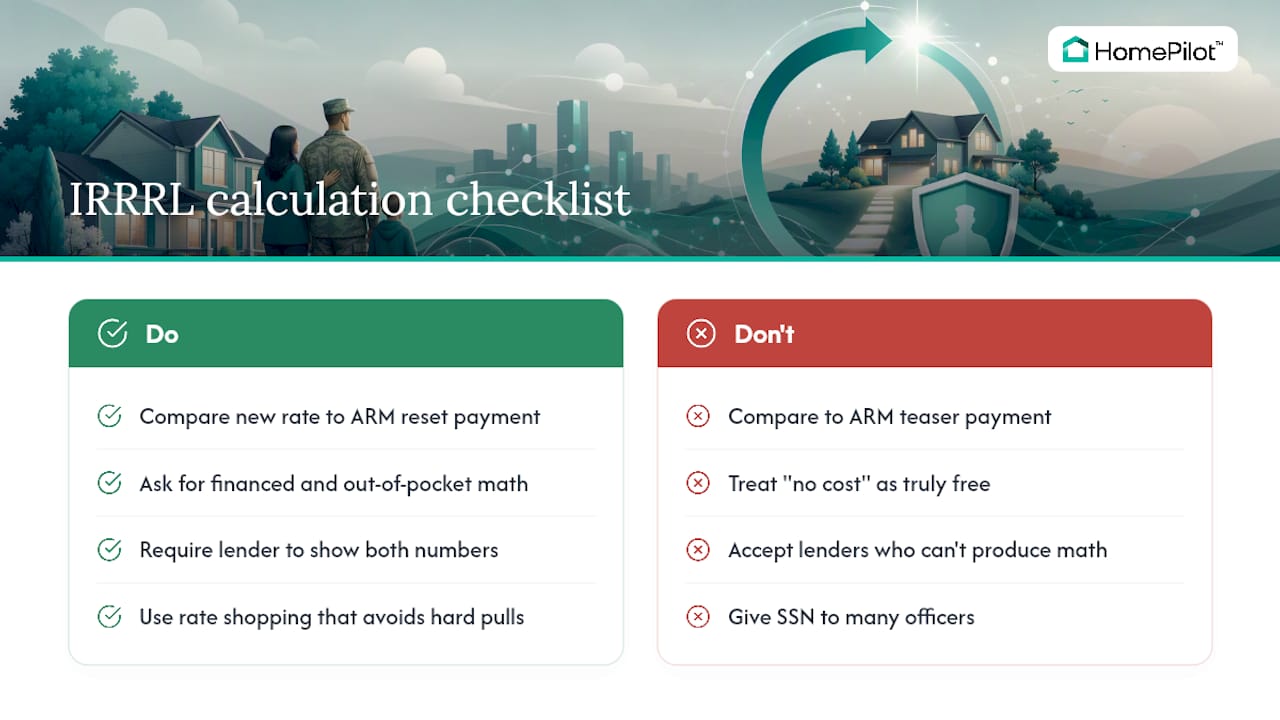
The other blind spot is treating “no cost at closing” as the same thing as “no cost.” Rolling fees into the loan is common, and it’s often the right call, but it quietly raises your principal and your lifetime interest. Ask for the math both ways: financed and paid out of pocket. A lender who can’t produce both numbers cleanly hasn’t done the work.
HomePilot’s model, matching veterans against wholesale pricing from more than 40 lenders without a hard credit pull for the initial quote, exists specifically because rate shopping shouldn’t require handing over your Social Security number five separate times to five separate loan officers.
Jack
Compare Your IRRRL Options Before You Commit
Most veterans get one quote, assume it’s competitive, and sign. That’s the expensive way to refinance. HomePilot Mortgage gives you live wholesale pricing across 40+ lenders from a single quote request, so you can see whether the offer in your inbox is actually good or just good enough.

Start with the refinance break-even calculator to see your recoupment timeline in real numbers, not a lender’s rounded estimate. Already have a Loan Estimate in hand from another lender? HomePilot Mortgage’s free loan estimate review will tell you, line by line, whether you’re leaving money on the table. No SSN required to get started, and no hard credit pull until you’re ready to move forward.
This article is general information, not a substitute for advice from a qualified financial advisor. Consult a qualified financial professional about your own circumstances before acting on anything here.